Topic 1.2: Cell Theory: Everything Alive Is Made of Little Rooms
Right now, as you read this, you are basically a walking apartment complex with tens of trillions of tiny residents, and every single one of them is busy. They take in food, make energy, haul out the trash, and follow instructions, all without a single complaint (and no rent). You can't feel any of it. So here's a question: how would anyone ever find out they were in there?
It took a good microscope, a curious mind, and a very ordinary piece of tree bark.
A Slice of Cork and a Room Full of Monks
In 1665, an English scientist named Robert Hooke published a book called Micrographia, full of drawings of things nobody had ever seen up close: fleas, fly eyes, the point of a needle. One of his drawings was a thin slice of cork. Under his microscope the cork wasn't solid at all. It looked like a honeycomb, rows and rows of tiny box-shaped compartments.

Hooke needed a name for them, and he picked one from everyday life. The small bare rooms where monks lived were called cells. The compartments in cork looked like rows of those little rooms, so he called them cells. The name stuck, and we still use it more than 350 years later.
Here's the twist: cork comes from bark, which is dead. The "rooms" Hooke saw were the empty walls left behind by plant cells that had once been alive. It's a bit like discovering apartment buildings by touring them after everyone moved out. He found the cells, but he never saw one doing anything.
The Cloth Merchant Who Found Life
The next breakthrough came from a man with no university degree. Antonie van Leeuwenhoek was a Dutch cloth merchant who taught himself to grind tiny glass lenses and mount them in little metal holders. He started out checking the quality of thread, then pointed his lenses at a drop of water. In a letter to the Royal Society in 1676, he described living things swimming around in it, creatures far too small to see without a microscope. He called them "animalcules," which means "little animals." We can only imagine what the first reaction to "there's a zoo in my water" must have been.

Hooke had found the rooms. Leeuwenhoek found that some living things are just one room, swimming, eating, and getting around all on their own.
Three Big Ideas
It took another century and a half to put it all together. In 1838, a German botanist named Matthias Schleiden concluded that plants are made of cells. In 1839, a zoologist named Theodor Schwann said the same thing about animals. Then, in 1855, a physician named Rudolf Virchow added the final piece, summed up in a Latin phrase that means "every cell from a cell": new cells come only from cells that already exist.
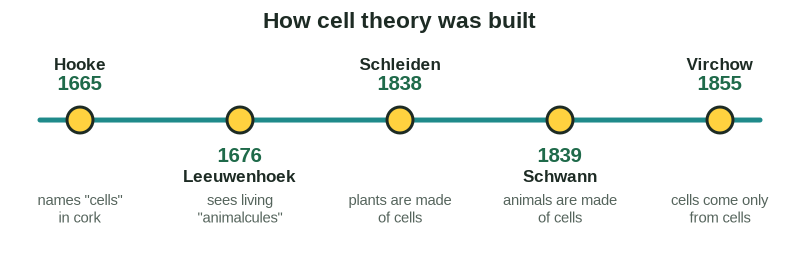
Put together, that gives us cell theory:
- All living things are made of cells.
- The cell is the basic unit of structure and function in living things. Cells are the smallest pieces that can do everything life does.
- New cells are produced from existing cells. Cells don't just pop up out of nowhere. They divide.
A quick word about the word "theory." In everyday talk, "theory" can mean a hunch. In science it means the opposite: an explanation that has been tested over and over and holds up. Cell theory is one of those. Scientists can still revise a theory if new evidence demands it, but this one has stood up for about 170 years.
One Cell or Trillions
Some living things are unicellular: a single cell does every job. Think of a bacterium as a whole life in a studio apartment: it handles its own kitchen, power plant, and trash pickup. The animalcules Leeuwenhoek found are examples. Others are multicellular: many cells working together, each specialized for a job. You are the big example. Multicellular life builds itself up in levels:
cells → tissues → organs → organ systems → organism

For example, muscle cells make up heart muscle tissue, which is the main part of the heart (an organ), which belongs to your circulatory system, which is part of you.
One thing to keep in mind: viruses carry genetic material and can copy themselves, but they aren't made of cells and can't reproduce on their own. Whether they count as alive is a debate scientists still have, and we'll come back to it in Unit 8.
More Videos on This Concept
Worth a Pause
Each of those trillions of cells is a working world: a tiny factory with its own power supply, its own instruction manual, and its own gatekeepers. The Psalmist wrote long before anyone had a microscope, "I will praise thee; for I am fearfully and wonderfully made" (Psalm 139:14). Hooke, Leeuwenhoek, and everyone since have been slowly finding out just how true that is. Over the next few topics, we'll tour the rooms.
In one line: Every living thing is made of cells, and every cell comes from another cell.
Practice Problems
- State the three parts of cell theory in your own words.
- Robert Hooke gave cells their name after looking at cork. What exactly did he see, and why wasn't he looking at living cells?
- How was Leeuwenhoek's discovery different from Hooke's?
- A friend says, "Cell theory is just a theory, which means it's only a guess." How would you respond?
- Give one example of a unicellular organism and one of a multicellular organism. How does a unicellular organism carry out all the jobs of life with only one cell?
- Put these in order from smallest to largest, and then give a human example for each: organ, cell, organism, tissue, organ system.
- In the 1800s, some people believed new cells could form out of nonliving material. Which part of cell theory shows this is wrong, and which scientist's work helped show it?
- Which of these is part of cell theory? (A) All cells have a nucleus (B) All living things are made of cells (C) All cells are the same size (D) New cells come only from plant cells
View Practice Problem Solutions →
Play to Practice

Try It: Meet the parts of a cell in Cell City: Organelle Match. Play Cell City: Organelle Match »