Topic 1.4: Organelles: The Little Organs Inside Every Cell
Picture a city with no city hall, no power plant, and no recycling trucks. It would shut down in a day. Every one of your cells runs a city like that, with its own buildings, workers, and delivery routes, and they are far too small to see.
You have probably heard that "the mitochondria is the powerhouse of the cell." It has been a classroom joke for years. But here's something you may not know: the phrase was popularized by a real scientist, Philip Siekevitz, in a 1957 Scientific American article. Electron microscopes had just let biologists see inside cells for the first time, and Siekevitz wanted to explain what the mysterious bean-shaped structures were doing. His answer was so catchy it is still on T-shirts almost seventy years later.
(One small correction to the joke: mitochondria don't create energy, because energy can't be created. They release the energy stored in food and capture it in a usable form called ATP.)
An organelle is a "little organ": a structure inside a cell that does a specific job. In eukaryotic cells many organelles are wrapped in their own membranes, which lets each one keep its own chemistry separate from the rest of the cell. Let's take the tour.
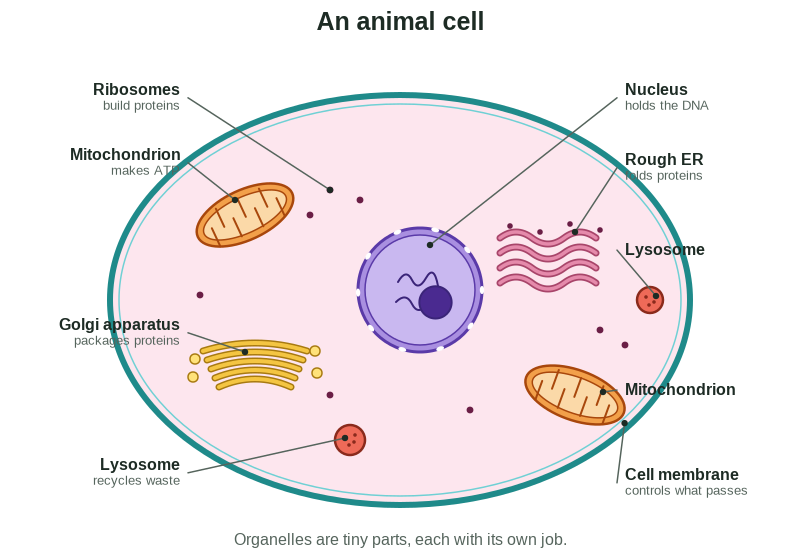
The Animal Cell
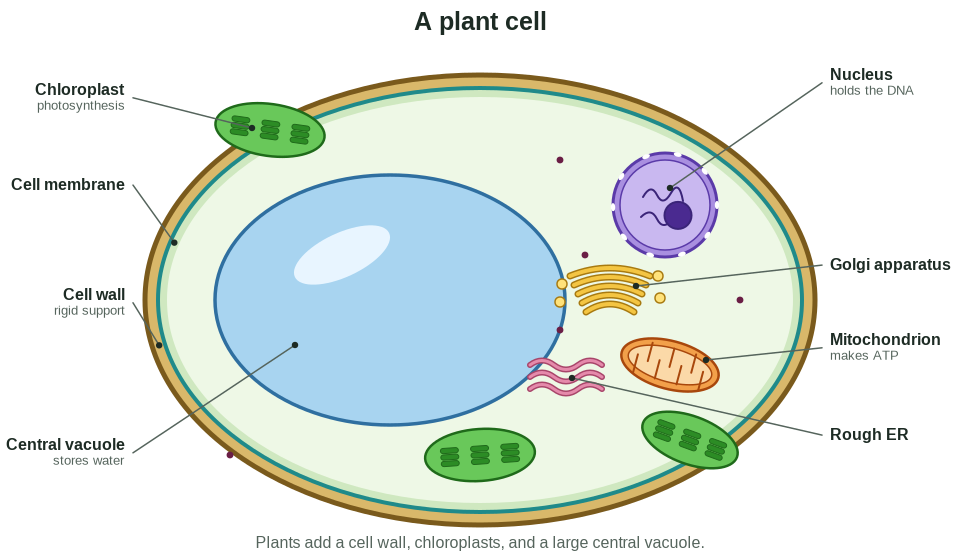
The Plant Cell
The Organelle Roster
| Organelle | Job | If a cell were a city... |
|---|---|---|
| Nucleus | Stores the DNA and directs the cell's activities | City hall, where the blueprints are kept |
| Ribosomes | Build proteins (not wrapped in a membrane) | Factory floor |
| Rough ER | Folds and moves proteins made by its attached ribosomes | A highway with factories along it |
| Smooth ER | Makes lipids and helps detoxify the cell | A specialty workshop |
| Golgi apparatus | Modifies, sorts, and packages proteins to ship out | Post office |
| Mitochondria | Release energy from food and make ATP | Power plant |
| Lysosomes | Break down waste and worn-out cell parts | Recycling center |
| Cell membrane | Controls what enters and leaves the cell | City border with security gates |
| Cytoskeleton | A web of protein fibers that gives shape and helps things move | Scaffolding and roads |
| Chloroplasts (plants) | Capture light and make sugar by photosynthesis | Solar farm |
| Central vacuole (plants) | Stores water and nutrients and keeps the cell firm | Water tower and warehouse |
| Cell wall (plants) | Rigid support outside the membrane | The strong outer city wall |
Two Energy Specialists
Mitochondria release energy from food: they "burn" sugar with oxygen to make ATP. Chloroplasts do nearly the reverse job for plants, using sunlight to build sugar. Both use the same trick: a folded inner surface. Folding a long ribbon lets you fit more of it into a small box, and folding a membrane lets a tiny organelle fit a huge amount of ATP-making machinery. A muscle or liver cell can have hundreds to thousands of mitochondria.


Teamwork: The Protein Assembly Line
Organelles rarely work alone. Take a protein that a cell exports, such as an enzyme or hormone. The instructions are in the DNA in the nucleus. A ribosome on the rough ER builds the protein. A small bubble (a vesicle) carries it to the Golgi, which modifies and packages it. Another vesicle then carries it to the cell membrane and delivers it outside.
Think of an online order. The DNA is the order form, the ribosome builds the item, the Golgi is the packing station, the vesicle is the delivery truck, and the cell membrane is the front door.

Worth a Pause
Nobody has ever built a living cell entirely from scratch. Even the simplest cell is a coordinated system of parts that pass materials down an assembly line, recycle their own waste, and make their own power. The Psalmist wrote, long before microscopes, "I will praise thee; for I am fearfully and wonderfully made" (Psalm 139:14). Every organelle we find in a microscope just adds another detail to that sentence.
In one line: Every part has a job, and the jobs fit together.
Practice Problems
- What is an organelle? Why is it helpful for a cell to have organelles wrapped in membranes?
- Which organelle holds the cell's DNA? Which builds proteins? Which makes most of the ATP?
- Match each organelle to its job: (a) lysosome (b) Golgi apparatus (c) rough ER (d) central vacuole. Jobs: stores water; packages and ships proteins; breaks down waste; folds proteins made by attached ribosomes.
- Name three structures found in plant cells but not animal cells.
- The "powerhouse of the cell" line is a nickname for which organelle? Explain why "makes energy" is not quite correct.
- Follow a protein that will be exported from the cell: list the organelles it passes through in order.
- Muscle cells have far more mitochondria than skin cells. What does that suggest about muscle cells?
- In the Cell City analogy, what organelle plays the role of (a) city hall (b) the recycling center (c) the power plant (d) the border with security gates?
View Practice Problem Solutions →
Play to Practice

Try It: Cell City: Organelle Match lets you click on organelles in an animal cell, a plant cell, and finally the whole Cell City. Play Cell City: Organelle Match »