Topic 2.1: DNA Structure: The Twisted Ladder That Holds the Code
A complete set of instructions for building you is stored in almost every one of your cells, in a molecule about two nanometers wide that would stretch to roughly two meters if you uncoiled it. That's a thread thousands of times thinner than a hair and about as tall as a doorway, folded into a space too small to see.
So how do you work out the shape of something you can't see? In 1952 the answer was a photograph that looks like a smudge. Here's how a blurry X on a dark background turned out to be the most important picture in biology.
On May 2, 1952, a graduate student named Raymond Gosling, working in the London lab of Rosalind Franklin, took the 51st X-ray photograph of a thin fiber of DNA. It is now called Photo 51: a fuzzy black X shape on a dark background. It doesn't look like much. But to a trained eye, that X pattern said "helix."
Early in 1953, the picture was shown to James Watson, who was building models of DNA with Francis Crick in Cambridge. Within weeks they had a model that fit the X-ray data and the chemistry: a double helix. In April 1953, Watson and Crick published their model in the journal Nature, and Franklin and Gosling published their supporting X-ray evidence in the same issue. Watson, Crick, and Maurice Wilkins shared the 1962 Nobel Prize. Franklin had died in 1958, and Nobel Prizes aren't given after death, but her careful work, and Gosling's, is now widely recognized as essential to the discovery.
A good scientific discovery rarely belongs to one person. It's a relay race, and this one ended with a picture of the most famous molecule in biology.
What Is DNA?
DNA (deoxyribonucleic acid) is a nucleic acid, one of the four macromolecules from Topic 1.1. It carries the instructions for building and running a living thing. In your cells, DNA is stored in the nucleus.
The Building Block: The Nucleotide
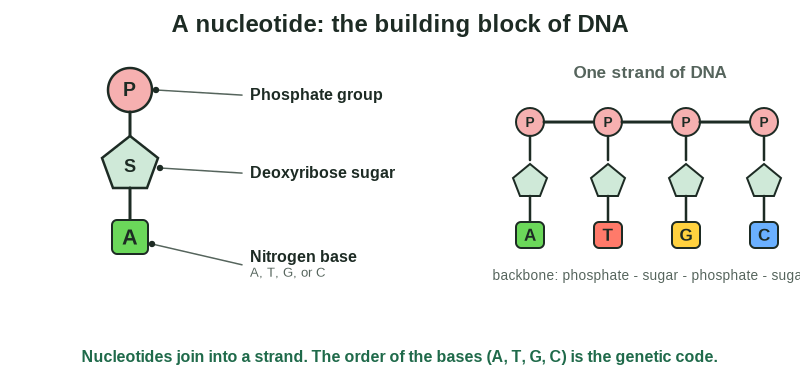
DNA is a polymer made of repeating monomers called nucleotides. Each nucleotide has three parts:
- A phosphate group
- A five-carbon sugar called deoxyribose
- A nitrogen base: adenine (A), thymine (T), guanine (G), or cytosine (C)
The phosphate and the sugar are the same in every nucleotide. The base is the only part that changes, like four different letters stamped on otherwise identical blocks.
The Double Helix
DNA is made of two strands wound around each other like a twisted ladder. The sugars and phosphates form the sides (the backbone). The bases meet in the middle to form the rungs, and they pair in only two ways:
- A pairs with T (two hydrogen bonds)
- G pairs with C (three hydrogen bonds)
The chemist Erwin Chargaff had already noticed that in any sample of DNA, the amount of A equals the amount of T, and the amount of G equals the amount of C. The base-pairing rule explains why. And because A always goes with T and G with C, each strand is a "mirror image" (a complementary strand) of the other. If you know one strand, you know the other. The two strands also run in opposite directions (called antiparallel).
Try the pairing rule as a number puzzle. If a sample of DNA is 30% A, it must also be 30% T. That's 60% so far, which leaves 40% for G and C. They pair up too, so each is 20%.

The Order Is the Code
The sides of the ladder are the same everywhere. What makes your DNA different from a daisy's is the sequence: the order of the A, T, G, and C along the strand. A gene is a section of DNA whose sequence carries the instructions for making one product, usually a protein. A human cell contains about 3 billion base pairs and roughly 20,000 protein-coding genes. Read aloud at one letter per second, 3 billion letters would take about 95 years.
Packing a Library Into a Closet
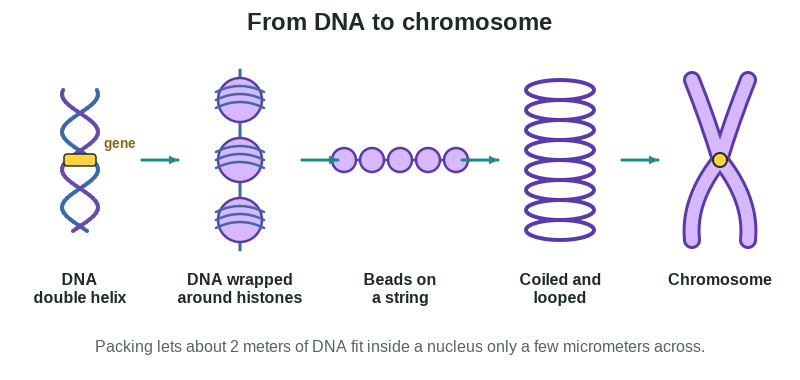
If you stretched out the DNA in one human cell, it would be about 2 meters long, but the nucleus is only a few micrometers across. That DNA is more than 300,000 times longer than the nucleus that holds it, like stuffing about 20 kilometers of thread into a tennis ball. Cells solve this with careful packing. DNA wraps around proteins called histones, forming "beads on a string." That string coils and loops into chromatin, and when a cell is about to divide, the chromatin condenses into the familiar X-shaped chromosomes. Humans have 46 chromosomes in most body cells.
More Videos on This Concept
Worth a Pause
Think about what that molecule does: four chemical letters, a code longer than a set of encyclopedias, copied perfectly in nearly every cell, and read by machinery that turns it into the proteins that build you. In everything else we know of, a code like that comes from a mind. Here's a short reflection along those lines:
In one line: Four letters, in the right order, are the instructions for building you.
Practice Problems
- Name the three parts of a nucleotide. What forms the backbone of a DNA strand?
- State the base-pairing rules for DNA. How many hydrogen bonds hold each pair together?
- One strand of DNA reads A-T-T-G-C-C-A. Write the complementary strand.
- A sample of DNA is 30% adenine. What percent is thymine? What percent is guanine and what percent cytosine? Explain.
- What is a gene? Where in the cell is most DNA found?
- Why does DNA have to be packed so tightly in a cell? Name the proteins that DNA wraps around.
- What makes the DNA of a human different from the DNA of a rose, if both are built from the same four bases?
- Photo 51 was taken by Raymond Gosling in Rosalind Franklin's lab. How did it help Watson and Crick?
View Practice Problem Solutions →
Play to Practice

Try It: Practice base pairing in Code Library: DNA Decoder, Level 1. Play Code Library: DNA Decoder »