Topic 2.5: Genetic Technology in Daily Life: From Insulin to CRISPR
If you or someone you know takes insulin, there is a good chance it was made by bacteria. Bacteria carrying a human gene, brewing human insulin in giant vats. That sounds like science fiction, and it has been routine medicine for decades.
For most of history, people with type 1 diabetes had a grim prognosis. Their bodies couldn't make the hormone insulin, and for decades the only treatment was insulin taken from the pancreases of cattle and pigs, which was slow, limited, and not identical to the human hormone.
Then, in 1978, scientists at Genentech and the City of Hope National Medical Center found a different way. They took the DNA instructions for human insulin and put them into bacteria. Those bacteria, treating the instructions like any other gene, read them and made human insulin. In October 1982, the U.S. FDA approved Humulin, the first medicine made with this recombinant DNA technology. A gene went in, a medicine came out.
That is genetic engineering: changing an organism's DNA on purpose. It is one of the most important uses of what you've learned in this unit.
The Toolkit
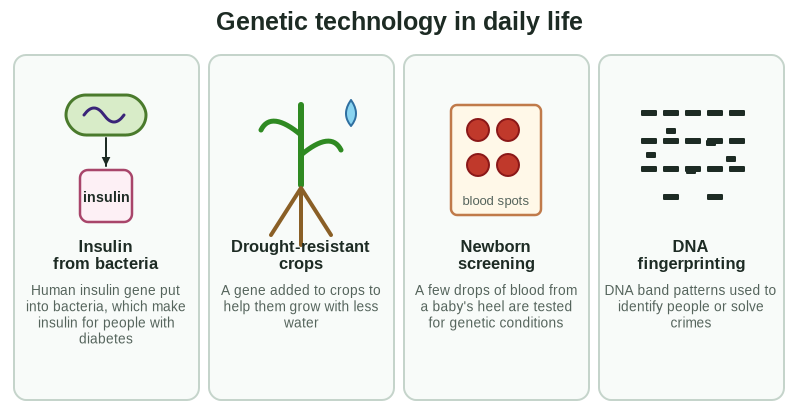
- Recombinant DNA. Scientists cut a gene out of one organism with enzymes (restriction enzymes) and splice it into a small loop of DNA called a plasmid, which is placed into bacteria or other cells. That's how insulin is made.
- GMOs (genetically modified organisms). Plants and animals with a gene added or changed. A well-known example is a crop given a gene that helps it survive drought, so it can grow with less water and help protect the food supply.
- Genetic screening. Newborns in the United States are routinely tested using a few drops of blood from a heel prick, to catch certain conditions early, when treatment can make the biggest difference.
- DNA fingerprinting. Because everyone's DNA sequence is slightly different, scientists can compare patterns of DNA fragments to identify people or solve crimes. Tools such as PCR (a molecular copy machine that turns a speck of DNA into billions of copies) and gel electrophoresis (which sorts DNA fragments by size) make it possible.
CRISPR: Editing DNA Like a Word Processor
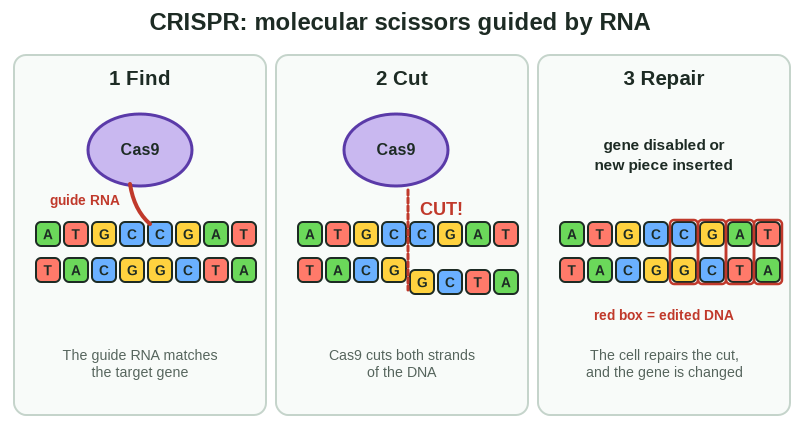
The newest tool is CRISPR-Cas9, developed from a defense system bacteria use against viruses. A guide RNA is built to match one specific spot in the genome. It leads a protein called Cas9, which acts like a pair of molecular scissors, to that spot and cuts the DNA. When the cell repairs the cut, scientists can disable a gene, or help the cell insert a new piece. Emmanuelle Charpentier and Jennifer Doudna received the 2020 Nobel Prize in Chemistry for developing this method.
Researchers are exploring uses from treating genetic diseases, to crops that resist disease, to species-specific pest control tools that target one harmful insect without affecting others.
Questions Worth Asking
Being able to do something is not the same as knowing we should. Good scientists and good citizens ask:
- Is it safe? For people, for other species, and for the environment?
- Who benefits, and who might be left out or harmed?
- Whose information is it? Genetic information is deeply personal. Who should be allowed to see it?
- Where are the lines? Treating a disease is different from trying to engineer traits that have nothing to do with health.
The Bible says, "Wisdom is the principal thing; therefore get wisdom" (Proverbs 4:7). The more power our science gives us, the more we need wisdom to go with it. And the more we learn how carefully life's code is written, the more reason we have to handle it with humility.
Worth a Pause
We can now read DNA, copy it, and even edit it, and each ability can heal or harm depending on who holds it. Being able to do something is never the same as knowing whether we should. Many people of faith, and many who claim none, agree that power over the code of life calls for humility, honesty and care for the person at the other end of the experiment. "Whatsoever ye would that men should do to you, do ye even so to them" (Matthew 7:12) is a decent test for any new technology.
In one line: Being able to edit the code is not the same as knowing we should.
Practice Problems
- What is genetic engineering? Describe how the human insulin gene is used to make insulin in bacteria.
- What is a plasmid, and why is it useful in genetic engineering?
- Give one example each of how genetic technology is used in (a) medicine (b) agriculture (c) forensics.
- What do PCR and gel electrophoresis do?
- Describe the three steps of CRISPR: find, cut, repair. What is the role of the guide RNA, and what is the role of Cas9?
- A farmer plants a crop that has a drought-resistance gene added. Name one possible benefit and one question people might ask about it.
- Why are newborns screened for certain genetic conditions? Why is early detection helpful?
- Genetic information is personal. Give one reason people might want to protect it, and one reason it can be useful to share with a doctor.
View Practice Problem Solutions →
Play to Practice

Try It: Test your knowledge of the code in Code Library: DNA Decoder. Play Code Library: DNA Decoder »