Topic 3.2: DNA Replication: Copying the Code
Before a cell splits, it has to copy about 3 billion letters of DNA. If you typed that out at one letter per second, nonstop, it would take you about a century. Your cell does it in a matter of hours, and after proofreading it makes roughly one mistake in a billion letters.
How do you copy something that big, that fast, that accurately? The answer was hiding in a single quiet sentence at the end of a famous paper.
When Watson and Crick described the double helix in 1953, they added a quiet sentence at the end of their paper: the pairing rules they'd found "immediately suggest a possible copying mechanism for the genetic material." If the strands are complements, each one can serve as a template for the other.
But how exactly? Scientists came up with three ideas. Maybe the whole double helix stays intact and builds a brand-new copy (conservative). Maybe the copy is a mix of old and new chunks (dispersive). Or maybe the strands separate and each builds a new partner (semiconservative).
In 1958, Matthew Meselson and Franklin Stahl settled it. They grew bacteria for many generations in food containing a "heavy" form of nitrogen (15N), so all the bacteria's DNA was heavy. Then they moved the bacteria to normal "light" nitrogen (14N) and let them copy their DNA once. When they spun the DNA in a centrifuge, it formed a single band halfway between heavy and light. The heavy nitrogen worked like a dye that marked the old strands, so the old could be told from the new. Each new molecule had one heavy strand and one light strand. Only the semiconservative idea fit. People still call it one of the most elegant experiments in biology.
Why Copy DNA?
Before a cell divides (Topic 3.1), it must give each daughter cell a full set of instructions. So during S phase of interphase, the cell copies every bit of its DNA. This is DNA replication.
Semiconservative Replication
The rule is simple: each new DNA molecule has one old strand and one new strand.
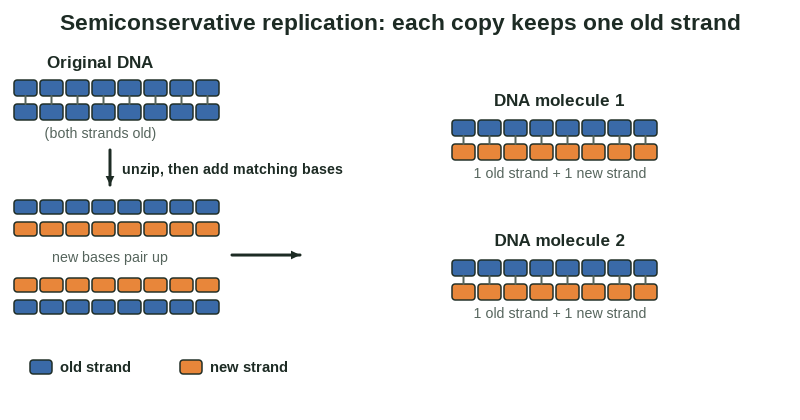
It works because of base pairing from Topic 2.1. If the old strand reads A-T-G-C, the new partner must read T-A-C-G. The old strand is the pattern, and the base-pairing rules do the rest.
The Enzymes at the Replication Fork
Replication isn't done by one machine. It's a team of enzymes, working at a Y-shaped spot called the replication fork:
- Helicase unzips the double helix by breaking the hydrogen bonds between the bases, like the pull on a zipper.
- DNA polymerase reads each old strand and adds matching nucleotides to build the new strand. It can only build in one direction, so one new strand is made smoothly and the other is built in short pieces.
- DNA ligase glues the short pieces together into one continuous strand.
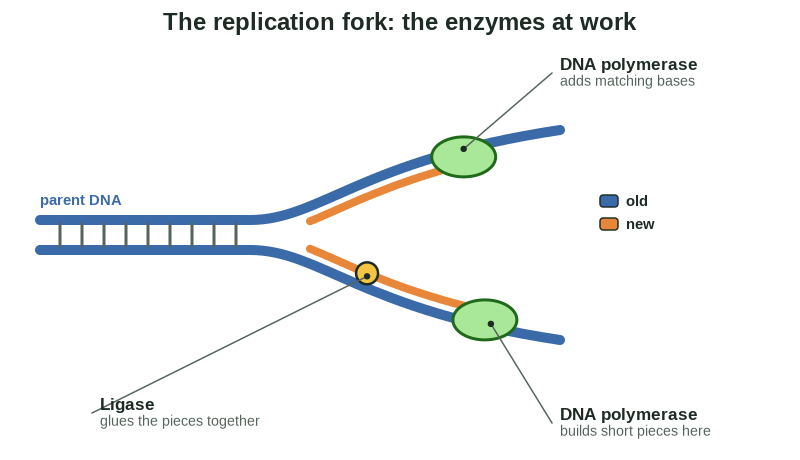
Replication doesn't start at one end and run to the other. In humans it starts at many places along each chromosome at once (tens of thousands of start points in a single cell). Without that, copying one long chromosome would take far too long.
Proofreading: Almost No Typos
Copying 3 billion letters could produce a lot of errors. But DNA polymerase proofreads as it goes: if it slips in a wrong base, it backs up and fixes it. Other repair proteins check the work afterward. The result is roughly one mistake per billion bases copied.
The rare mistakes that slip through are called mutations. Most are harmless. A few can change a protein, and some can cause problems (we'll see one example in Topic 3.4). A mutation in a body cell isn't passed to your children, but it is passed to that cell's daughter cells.
Replication vs. Transcription: Don't Mix Them Up
| Replication | Transcription | |
|---|---|---|
| Purpose | Copy all the DNA before cell division | Copy one gene into RNA to make a protein |
| Product | Two DNA molecules | One RNA molecule |
| Enzyme | DNA polymerase | RNA polymerase |
| When | S phase | Any time a gene is needed |
Worth a Pause
A copying machine this accurate, running inside a cell too small to see, using nothing but chemistry... It's no wonder people have long seen the hand of a Designer in the cell. At the very least, it should make us humble about how much is happening inside us right now.
In one line: Every new DNA molecule keeps one old strand and builds one new one.
Practice Problems
- During which phase of the cell cycle does DNA replication occur? Why must it happen before mitosis?
- What does "semiconservative" mean? What does each new DNA molecule contain?
- An old DNA strand reads A-A-C-G-T-T-G. Write the new strand that is built against it.
- Name the three enzymes from this lesson and give the job of each.
- Why do replication forks open at many places along a human chromosome?
- Meselson and Stahl's DNA, after one generation in light nitrogen, formed a single band halfway between heavy and light. What does that tell you about the new DNA molecules?
- What is a mutation? Why are most copying errors fixed before they become mutations?
- List two differences between replication and transcription.
View Practice Problem Solutions →
Play to Practice
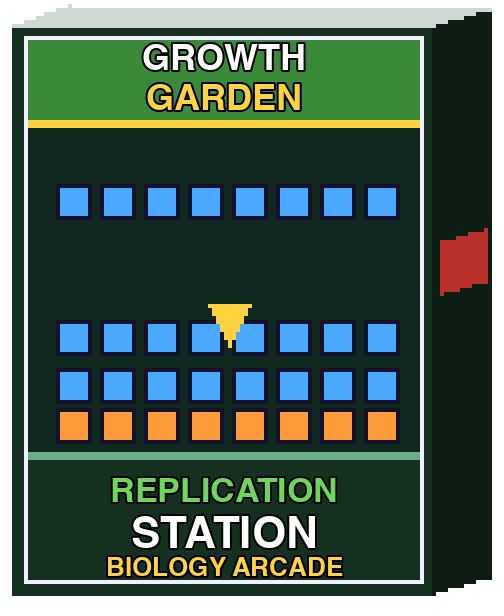
Try It: Growth Garden: Replication Station. Copy a DNA strand with base pairing, see old and new strands, and meet the enzyme crew. Play »

Try It: Code Library: DNA Decoder. Pair the bases, copy DNA into mRNA, read the codons, run the whole chain, then spot mutations. Play »