Topic 4.1: Water: The Molecule That Makes Life Possible
When space agencies send probes to Mars, one of their favorite slogans is "follow the water." Why? Because every living thing we know of, from bacteria in a Gulf Coast marsh to the person reading this, depends on liquid water. You are roughly 60% water. A jellyfish is more than 95%. For a 150-pound person, that 60% works out to about 90 pounds of water, roughly 11 gallons.
The Bible points to the same thing. The second verse of Genesis mentions the waters before anything else is described in detail. Water isn't just a background to life. It's one of the key ingredients in how life works.
So what's so special about a molecule with just three atoms?
Water Is Polar
A water molecule (H2O) has one oxygen atom and two hydrogen atoms. The oxygen atom pulls the shared electrons closer to itself. That makes the oxygen end of the molecule slightly negative and the hydrogen ends slightly positive. A molecule with a positive end and a negative end is called polar, like a tiny magnet.
Because the ends carry opposite charges, the positive hydrogen of one water molecule is attracted to the negative oxygen of the next. That attraction is a hydrogen bond. One hydrogen bond is weak. But billions of them add up to something strong.

Three Properties That Keep You Alive
1. Cohesion: water sticks to water
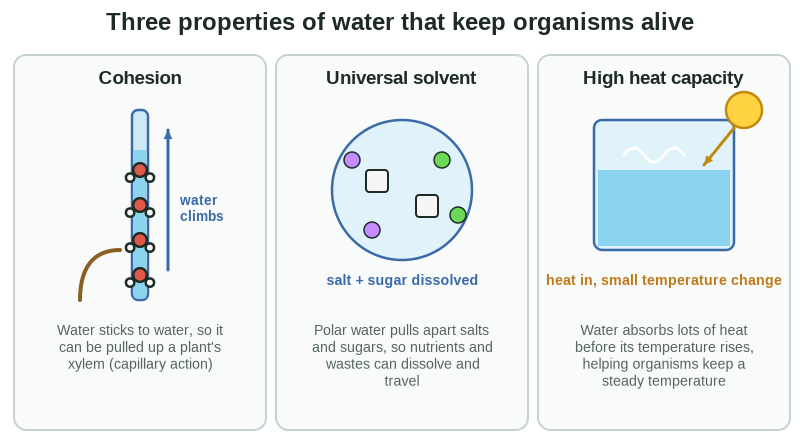
Because of hydrogen bonds, water molecules hold onto each other. That's cohesion. It's why water forms beads and why a water strider can walk across a pond (surface tension). It's also why a belly flop off a diving board hurts: breaking through the surface takes real force.
Cohesion also lets plants move water. Water evaporates from leaves, and because the molecules are linked, each one pulls the next up the plant's narrow tubes (the xylem). Water also sticks to the tube walls (adhesion). Together this is called capillary action, and it's how a tree can lift water over 100 feet with no pump at all.
2. The universal solvent
Water is called the universal solvent because more substances dissolve in it than in any other liquid. The positive and negative ends of water molecules pull apart salts and surround other charged or polar molecules. This is why your blood can carry sugar, salts, and oxygen around the body, and why chemical reactions in cells can happen in water.
(Oils and fats are nonpolar. They don't dissolve in water, which is the key to how the cell membrane works. See the next topic!)
3. High heat capacity: a steady temperature
Water takes a lot of heat energy to warm up and gives it up slowly when it cools. That's called high specific heat (or heat capacity). It means water resists big temperature changes. Think of a summer afternoon on the Gulf: the sand is too hot to walk on, but the water is still cool. Same sunshine, but water takes far more energy to warm up. Because your body is mostly water, your temperature stays steady even when the air around you swings from hot to cold. The Gulf of Mexico does the same for the Alabama coast: the water warms slowly in spring and stays warm into fall, which moderates the climate. Life in a pond or ocean also stays steady, because the water doesn't heat up or cool down in a hurry.
Why This Matters for Homeostasis
Homeostasis means keeping conditions inside an organism steady and stable. Water helps in all three ways: it dissolves and carries materials (solvent), it cushions temperature changes (heat capacity), and it lets plants move water to every leaf (cohesion). You'll see in the next topics that the cell membrane is built to work in a watery world.
Worth a Pause
Psalm 104 praises God for providing water for the animals, the plants, and people. Next time you drink a glass of water, remember it's doing four jobs for you at once: dissolving, carrying, cooling, and cushioning.
In one line: A tiny bent molecule that sticks to itself makes life possible.
Practice Problems
- Why is a water molecule called polar? Which end is slightly negative?
- What is a hydrogen bond? Why is it important that billions of them form between water molecules?
- Define cohesion and adhesion. How do they help a tree move water to its leaves?
- Why is water called the "universal solvent"? Give an example from the human body.
- A swimming pool warms up much more slowly than the air on a sunny day. Explain using heat capacity.
- Explain how the properties of water help an organism maintain homeostasis. Use at least two properties.
- Oil doesn't mix with water. Which of the two is polar? Explain.
- A water strider walks across a pond. Which property of water makes that possible?
View Practice Problem Solutions →
Play to Practice
Try It: Test your knowledge of polarity, cohesion, solvent and heat capacity in Membrane Gate: Water Works. Play Membrane Gate: Water Works »