Topic 4.5: Keeping Balance: What Speeds Up Transport, and How Bodies Stay Steady
Your body temperature stays close to 98.6°F (37°C) whether you're in a snowstorm or standing in an Alabama parking lot in August. Your blood sugar stays steady whether you just ate or haven't eaten for hours. Nobody is consciously steering any of it.
Keeping the inside steady while the outside changes is one of the great tricks of living things, and it started with a French physiologist noticing something odd about warm-blooded animals.
In the 1850s, a French physiologist named Claude Bernard noticed something that seemed to violate the rules of nature: warm-blooded animals stay at nearly the same temperature whether they are in a snowstorm or a hot barn. He said the secret was the "constancy of the internal environment." In 1926 an American physiologist named Walter Cannon gave it a name from Greek: homeostasis, "staying the same."
Homeostasis is the ability of an organism to keep its internal conditions stable, even when the outside world changes. It's the main idea of this whole unit. Water, the membrane, and the different kinds of transport you've just studied are the tools cells use to do it.
What Controls How Fast Things Move?
Before we look at whole bodies, let's go back to the cell. Scientists who study diffusion test what changes how fast it happens. Here are the main factors:
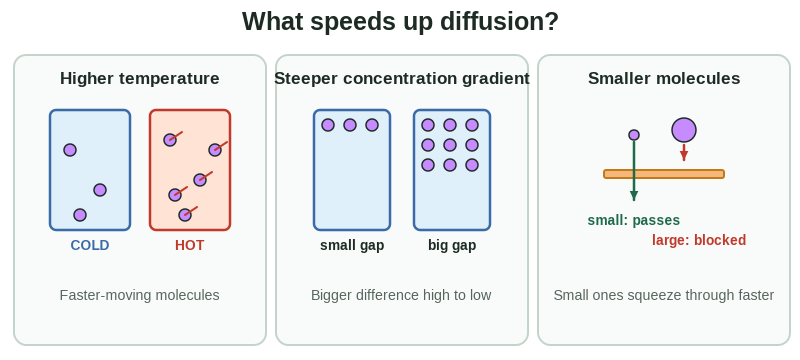
- Temperature. Hotter means the molecules are moving faster, so diffusion speeds up.
- Concentration gradient. The bigger the difference between high and low, the faster the net movement. As the two sides even out, the movement slows down.
- Size of the molecules. Small molecules move and squeeze through faster than big ones.
- Surface area. More membrane means more room for things to cross. This is why the lining of your small intestine is folded into tiny fingers (villi), and why cells stay small: a small cell has more surface area compared to its volume.
(For active transport the key factor is the supply of ATP. No energy, no pumping.)
Try It at Home: A Diffusion Race
Fill two clear cups, one with cold water from the fridge and one with hot (not boiling) tap water. Let them sit still. Add one drop of food coloring to each at the same time and watch.
- Which one spreads faster?
- Why? (Hint: What is different about the water molecules?)
This kind of experiment is exactly how scientists collect evidence about diffusion. If you time how long it takes the color to spread across the cup, you can graph temperature against speed.
Homeostasis: Feedback Loops
How does a body keep a variable (like temperature) steady? With a negative feedback loop, which works like a thermostat in a house.
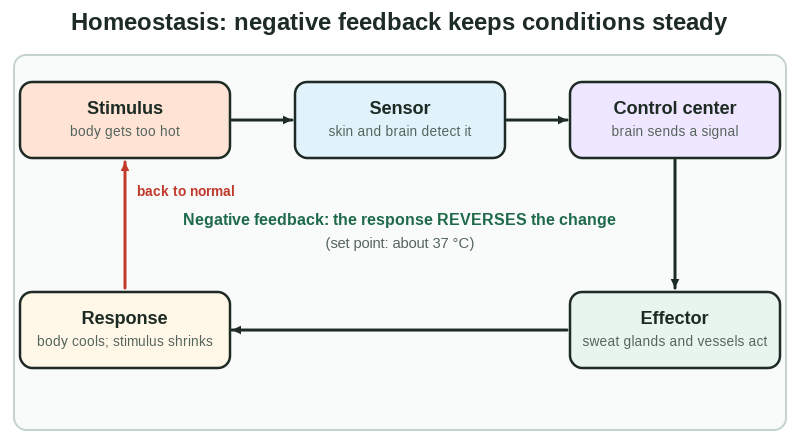
- Stimulus: something changes (you get too hot).
- Sensor: nerve endings in your skin and brain detect it.
- Control center: your brain compares it to the set point (about 37 °C) and sends a signal.
- Effector: sweat glands release sweat and blood vessels in the skin widen. (That's why your face turns red when you work out.)
- Response: you cool down, the stimulus shrinks, and the loop shuts off.
It's called negative because the response goes in the opposite direction from the change. If you get too cold, the loop runs the other way: you shiver, blood vessels narrow, and heat is saved.
(There's a rarer kind, positive feedback, where the response pushes the change further. Childbirth contractions and blood clotting are examples. It speeds a process up to completion and then stops.)
More Examples of Homeostasis
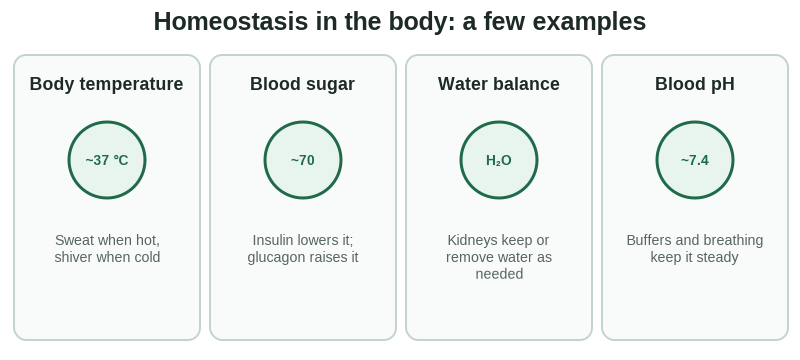
- Blood sugar: after a meal, rising blood sugar signals the pancreas to release insulin, which makes cells take in glucose (using transport proteins). Blood sugar falls. If it falls too low, the hormone glucagon raises it.
- Water balance: if you're low on water, your brain tells your kidneys to save water, and you feel thirsty. If you drink too much, the kidneys make more urine. This depends on the active transport and osmosis from the last two topics.
- Blood pH: chemicals called buffers and your breathing rate keep blood acidity in a narrow range. Even a small shift can make proteins stop working.
Homeostasis works at every level: inside one cell, in a tissue, and in the whole body. When it fails, you get sick. Diabetes, for example, is a failure of blood sugar control.
Worth a Pause
The constant, quiet balancing act in your body is like a thousand thermostats running at once, none of which you have to think about. Colossians 1:17 says of Christ, "in him all things hold together." We can look at the feedback loops that hold us together and say: that's a good description.
In one line: Keep the inside steady while the outside changes.
Practice Problems
- Define homeostasis. Why does your body need it?
- Name three factors that affect how fast diffusion happens, and say how each one changes the speed.
- A student drops food coloring into hot water and cold water. Predict which spreads faster and explain why.
- List the parts of a negative feedback loop in order, using body temperature as the example.
- What makes a feedback loop "negative"?
- After a big meal your blood sugar rises. Explain how the body brings it back down.
- Why do cells stay small? Explain using surface area.
- A kidney patient can't make enough ATP in the kidney cells. Predict a problem and explain using active transport.
View Practice Problem Solutions →
Play to Practice
Try It: Membrane Gate: Feedback Loop Builder. Build negative feedback loops for body temperature, blood sugar, and water balance. Play »

Try It: Membrane Gate: Cell Transport. Diffusion, facilitated diffusion, osmosis, or active transport? Read the membrane and decide. Play »