Topic 5.5: Two Processes, One Loop
The oxygen in your next breath was made by a plant, an alga, or a cyanobacterium. And the carbon dioxide you exhale becomes food for a plant. You and the plants are in a loop, each one's waste is the other's supply.
What happens when you try to build that loop by hand, sealed inside a glass building? Eight people found out.
In 1991, eight scientists walked into Biosphere 2, a huge sealed glass-and-steel structure in the Arizona desert, about the size of three football fields. It held a rainforest, an ocean, a desert, farmland, and about 3,800 species of plants and animals. The plan was to live there for two years with nothing coming in or out except sunlight. The idea was to see whether a closed ecosystem could support people.
It was a remarkable experiment, and a humbling one. Over about 16 months, the oxygen level in the air slowly fell from 21% to about 14% (like living high on a mountain), and the crew eventually had to have oxygen pumped in. Scientists later worked out that microbes in the rich soil were using up oxygen faster than the plants could make it, and carbon dioxide levels swung wildly.
Biosphere 2 showed how delicate the balance is between the two processes you've been studying.
On a small scale, though, the loop can work. In 1960 a man in England planted a spiderwort in a large glass bottle, watered it once in 1972, and sealed the bottle. Decades later the plant was still thriving, recycling its own air and water. On Earth, it works so smoothly that most of us never think about it.
The Loop
Put the equations next to each other:
- Photosynthesis: CO2 + H2O + light → glucose + O2
- Cellular respiration: glucose + O2 → CO2 + H2O + ATP + heat
The products of one are the reactants of the other. Photosynthesis builds the glucose and oxygen that respiration uses. Respiration releases the carbon dioxide and water that photosynthesis uses.
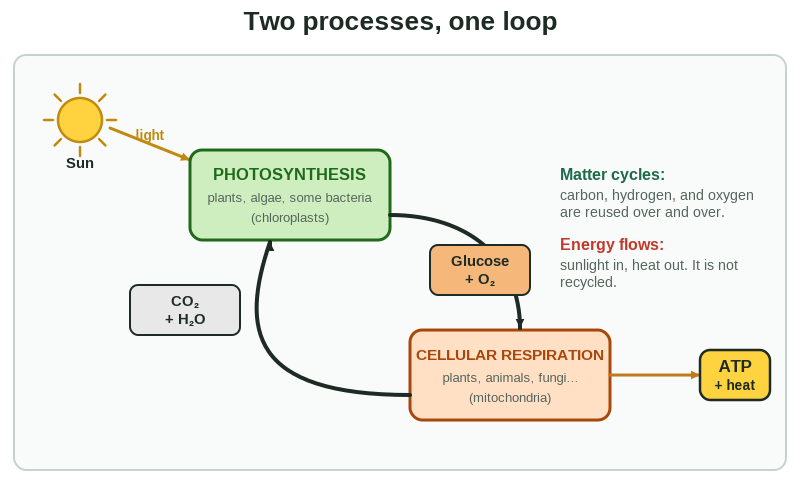
Matter cycles; energy flows. The atoms of carbon, hydrogen, and oxygen are used again and again. A carbon atom in the CO2 you breathe out might be pulled into a leaf tomorrow, become part of a sugar, and end up in someone's lunch. But energy doesn't cycle. It enters as sunlight, gets stored in glucose, passes to ATP, and ends up as heat. New sunlight has to arrive every day.
Side by Side

A common mix-up is thinking plants do photosynthesis and animals do respiration. In fact, plants do both. They make glucose by photosynthesis, and then, just like you, they break it down by cellular respiration to make ATP, day and night. Animals, fungi, and most microbes can only do respiration, which is why they depend on photosynthesizers for food and oxygen.
Connecting to the Whole Planet
Because photosynthesis uses CO2 and respiration releases it, these two processes help control the amount of carbon dioxide in the air, a point we'll pick up in Unit 6 when we follow carbon around the ecosystem. Energy from the Sun enters the food web through photosynthesis, and every living thing spends it through respiration, all the way up to the top predator.
Worth a Pause
The whole Earth runs on a partnership: plants and algae give oxygen and food, animals and microbes give back carbon dioxide, and the Sun pays the bill. Psalm 19:6 says of the Sun, "its circuit... to the end of them, and there is nothing hidden from its heat." Biosphere 2 cost well over $100 million and couldn't quite keep eight people breathing. Our planet has been doing it for everyone, for free.
In one line: What one process throws away, the other uses.
Practice Problems
- Write the equations for photosynthesis and cellular respiration. What do you notice?
- Explain what "matter cycles but energy flows" means.
- Where does the energy that ends up in your ATP originally come from?
- True or false: plants only do photosynthesis. Explain.
- Which organisms can do cellular respiration but not photosynthesis? How do they get glucose?
- A sealed terrarium with a plant and a snail survives for months. Explain how the two processes support each other.
- In the dark, what happens to the oxygen level inside a sealed jar with a plant?
- Biosphere 2's oxygen levels fell. Use the two processes to give one possible reason.
View Practice Problem Solutions →
Play to Practice
Try It: Finish the unit in Power Plants: Energy Swap, especially Level 2, "The Loop." Play Power Plants: Energy Swap »