Topic 6.3: Cycling Matter: Carbon, Nitrogen, Phosphorus, and Sulfur
The carbon atoms in your body have been used before. Some were in the air last week. Some were in a tree, or a fish, or a prehistoric fern. Earth doesn't make new matter, it recycles what it has.
The biggest carbon flow of all is the carbon dioxide in the air, and one scientist decided to keep track of it with a single instrument on top of a volcano.
In 1958, a young chemist named Charles David Keeling set up an instrument on top of Mauna Loa, a volcano in Hawaii, to measure carbon dioxide in the air. He chose that spot because it is far from cities and forests that could confuse the reading.
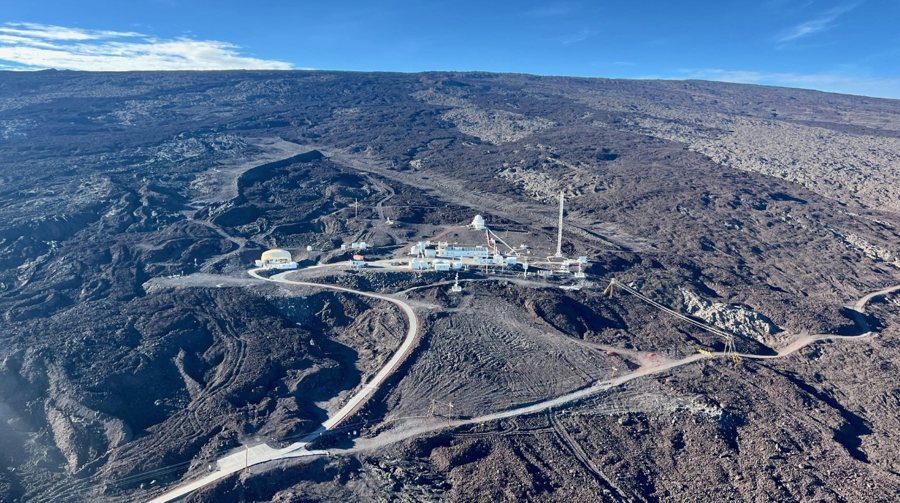
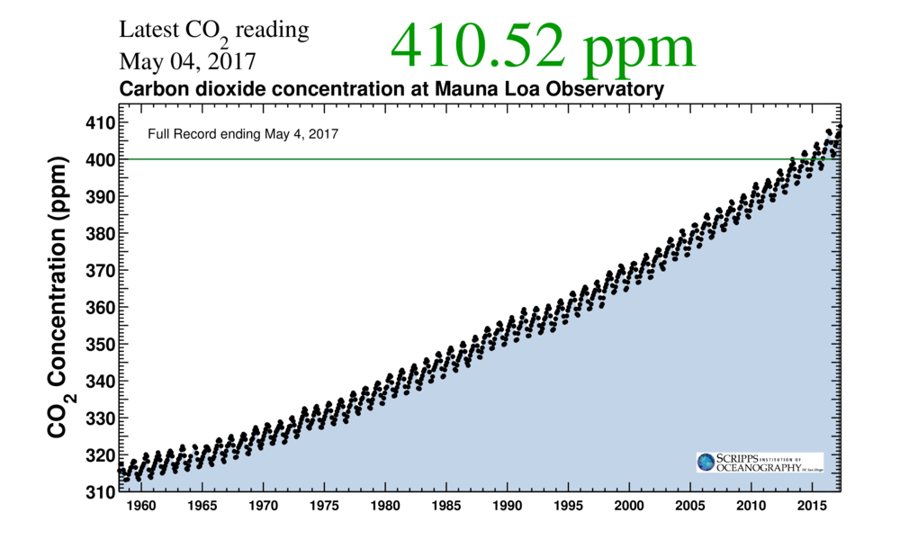
What he found was surprising. The CO2 level rose and fell like a heartbeat, every year. It dropped in the Northern Hemisphere's spring and summer, when leaves were growing and pulling CO2 into photosynthesis, and rose again in fall and winter when leaves died and decayed. The whole planet was breathing, and Keeling had measured it. The graph is called the Keeling Curve, and it also shows that, year after year, the overall level has been climbing.
That breathing is a clue to a basic rule of ecosystems: matter cycles.
Energy Flows, Matter Cycles
In Topic 6.2 we saw that energy flows one way through an ecosystem, from the Sun to heat. But the atoms that make up living things are not made new and not used up. The law of conservation of matter says matter can change form but is never created or destroyed. The same carbon, nitrogen, and other atoms are used by one organism after another, again and again, moving between the biotic (living) and abiotic (nonliving) parts.
The atoms in your body have been in rocks, air, plants, and other animals before they were in you. Some of them might once have been part of a dinosaur, a fish, or a pine tree.

These paths are called biogeochemical cycles (bio = living, geo = Earth, chemical). You don't need to memorize every step. The key idea is the exchange of elements between living things and the nonliving world.
The Carbon Cycle
Carbon is the backbone of every sugar, fat, protein, and DNA molecule. It moves like this:
- Into living things: plants pull CO2 from the air during photosynthesis and build it into sugar.
- Through the food web: animals eat plants (and each other), passing the carbon along.
- Back to the air: every organism, plant, animal, or microbe, releases CO2 by cellular respiration. Decomposers release it as they break down dead material.
- Into storage: some carbon is locked away for millions of years in coal, oil, and natural gas (fossil fuels). Burning them releases CO2 quickly.

The Nitrogen Cycle
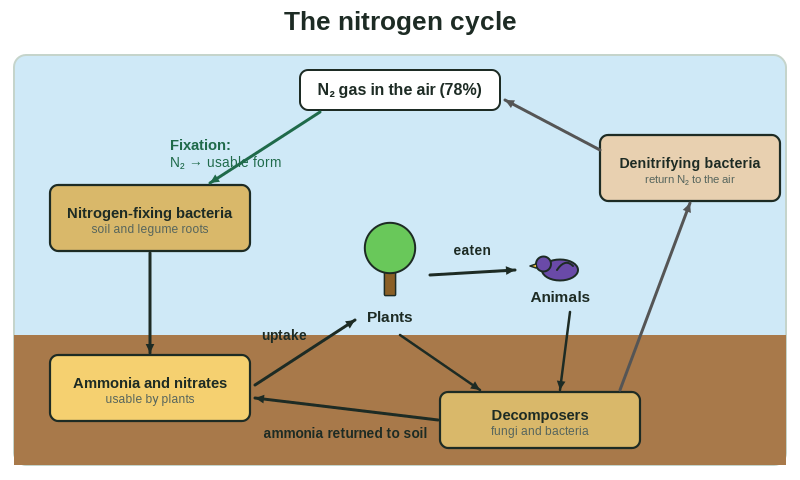
Nitrogen is in every protein and in DNA. About 78% of the air is nitrogen gas (N2), but plants and animals can't use it in that form. Two nitrogen atoms are held together by a triple bond so strong that it works like a locked safe, and only certain bacteria (and lightning) have the key. They need it "fixed" into a usable form:
- Nitrogen fixation: certain bacteria (in the soil and on the roots of plants like peas, beans, and clover) convert N2 into ammonia and nitrates. Lightning also does a little.
- Uptake: plants absorb nitrates from the soil and build protein.
- Through the food web: animals get nitrogen by eating plants or other animals.
- Decomposition: decomposers break down dead matter and wastes, returning ammonia to the soil.
- Back to the air: denitrifying bacteria convert some nitrates back to N2 gas.
Farmers add nitrogen fertilizer to help crops grow. That's useful, but when rain washes extra nitrogen into streams, it can cause trouble downstream (Topic 6.6).
Phosphorus and Sulfur
- Phosphorus is in DNA, ATP, and bones. Unlike carbon and nitrogen, it has no gas phase. It cycles between rocks, soil, water, plants, and animals, and it moves slowly.
- Sulfur is part of some amino acids and proteins. It moves through rocks, volcanoes, the air, soil, and living things.
For this course, the important thing is the overall pattern: each of these elements moves back and forth between the nonliving world and living things, and no atom is created or destroyed.
Worth a Pause
"Dust you are, and to dust you will return" (Genesis 3:19) is a sentence about matter cycling. The material that makes up our bodies came from the earth and goes back to it, in an orderly cycle that keeps the whole system supplied. Nothing is wasted.
In one line: Energy flows through. Matter goes around.
Practice Problems
- Explain "energy flows but matter cycles."
- Name four elements that cycle through ecosystems and one use of each in living things.
- Describe how carbon gets from the air into a plant and back into the air.
- Name two ways carbon dioxide gets back into the air.
- Why can't most organisms use nitrogen gas from the air? What converts it into a usable form?
- Why are decomposers important to the cycling of matter?
- What does the Keeling Curve show about the Northern Hemisphere's plants?
- The law of conservation of matter says matter isn't created or destroyed. How does that fit the carbon cycle?
View Practice Problem Solutions →
Play to Practice

Try It: Follow carbon and nitrogen in Alabama Wilds: Cycle Tracer. Play Alabama Wilds: Cycle Tracer »