Topic 6.7: Resilience, Succession, and Recovery
Find a crack in a sidewalk. Within weeks, something green is growing in it. Leave a lot alone in Alabama for a few years and you get weeds, then shrubs, then young pines. Nature does not leave empty ground empty for long.
But what happens after the worst possible wipe-out, an event that leaves nothing at all? A mountain in Washington State ran that experiment in 1980.
On May 18, 1980, Mount St. Helens in Washington erupted in the most destructive volcanic event in US history. It blew the top off the mountain and flattened or buried more than 200 square miles of forest in ash and mud. Scientists called the area the "blast zone," and many assumed it would be a barren wasteland for decades.


Within a year, tiny green plants were poking through the ash. Lupines, a flowering plant that can make its own nitrogen with help from bacteria, were among the first. Insects blew in. Birds and small mammals followed. Within a few decades, much of the blast zone was alive again.
Nature is not fragile in the way we sometimes picture it. Many ecosystems are resilient: they can recover from a disturbance. This topic is about how.
Disturbance and Resilience
A disturbance is an event that changes an ecosystem: fire, hurricane, flood, volcano, disease, or human activity like logging. Resilience is an ecosystem's ability to recover from a disturbance. Stability is its ability to stay the same despite changes.
Ecological Succession
Succession is the gradual, predictable series of changes in a community over time as species replace one another.

There are two kinds:
- Primary succession starts where there is no soil, like fresh volcanic rock or ground exposed by a retreating glacier. Pioneer species such as lichens and mosses arrive first. They break down rock and add dead material, slowly building soil. Then grasses, shrubs, and eventually trees move in.
- Secondary succession starts where there was a community, and the soil is still there, such as after a forest fire, a storm, or an abandoned farm. It is much faster, because the soil and seeds are already present. Weeds and grasses return first, then shrubs, and then trees.
An easy way to remember: primary means starting from scratch, on bare rock. Secondary means a second try, with the soil still there.
Eventually the community becomes relatively stable, often called a climax community (a mature forest in much of Alabama). In reality, change continues, and disturbances restart the process.
Fire: Sometimes Part of the Plan
We usually think of fire as a disaster. But some ecosystems depend on fire. A good example is the longleaf pine forest of the southeastern coastal plain, including south Alabama.
Longleaf pines evolved with frequent, low-intensity fires started by lightning. Fire:
- clears out leaf litter and brush that would shade the ground,
- releases nutrients into the soil,
- helps longleaf seeds sprout on bare soil,
- keeps the forest open and grassy, which many plants and animals (like the gopher tortoise and the red-cockaded woodpecker) need.
Young longleaf pines even look like clumps of grass for several years, protecting their growing tips from fire.

For about a century, people put out every fire as quickly as they could (fire suppression). Without fire, thick brush and hardwood trees crowded in, seedlings didn't sprout, and the open forest and its wildlife declined. Today, foresters use prescribed burns, small, planned, controlled fires, to restore and protect this habitat.
The evidence for this claim comes from field observations: forests that burn regularly have more species of grasses and flowers and more longleaf seedlings than forests that go unburned for decades.
Biodiversity and Resilience
Ecosystems with more species tend to be more resilient. One reason is functional redundancy: several species do the same job, so if one disappears, the others keep the ecosystem working.
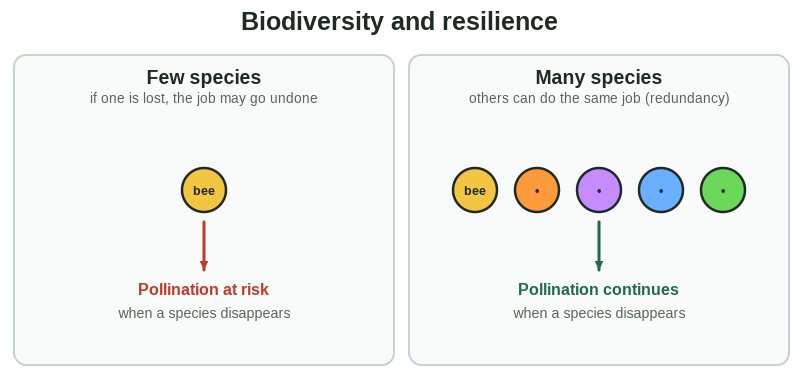
If a forest has only one kind of pollinator and it disappears, no pollination happens. If it has many, the others can fill in. Healthy ecosystems have this built-in backup, which helps them recover from fires, storms, and disease.
Worth a Pause
"He makes the grass grow" (Psalm 147:8). After a volcano, a fire, or a flood, the grass really does come back, often faster than anyone expected. Ecological recovery is one of the most hopeful things biology teaches us. It also reminds us that our job isn't to wreck things and hope nature cleans up, but to give it the room and the care to heal.
In one line: Nature recovers, and often faster than we would guess.
Practice Problems
- Define disturbance and resilience. Give an example of each.
- What is the difference between primary and secondary succession? Which is faster, and why?
- What are pioneer species? Give two examples and explain their job.
- Put these in order for primary succession: shrubs, bare rock, lichens, grasses, mature forest.
- Why does longleaf pine need fire? List two benefits of low-intensity fire.
- What happened to many fire-dependent forests when people suppressed all fires?
- What is functional redundancy? How does it make an ecosystem more resilient?
- A farmer abandons a field. Predict the stages of succession over the next 50 years.
View Practice Problem Solutions →
Play to Practice
Try It: Put succession stages in order in Alabama Wilds: Succession Sorter. Play Alabama Wilds: Succession Sorter »