Topic 7.2: Crossing Over and New Combinations
Even with 8 million ways to shuffle chromosomes, nature adds one more twist. Before they split apart, paired chromosomes swap pieces. So the chromosome your parent handed you is not a copy of one of your grandparents' chromosomes. It is a patchwork of both.
That is part of why brothers and sisters can look so different. A student working in a crowded room full of fruit flies figured out the first map.
In 1911, a young student named Alfred Sturtevant was working in the "Fly Room" of Thomas Hunt Morgan at Columbia University, studying fruit flies. Morgan's group had noticed that some traits tended to be inherited together, but not always. Sturtevant realized that the traits were probably on the same chromosome, and that the chance of two traits being separated depended on how far apart they were.
He later wrote that he went home and spent most of the night, to the neglect of his undergraduate homework, drawing the first genetic map. It was a line of genes in order on a chromosome, with distances based on how often they were separated.
What separated them? A process called crossing over.
Crossing Over
Early in meiosis I (prophase I), each chromosome pairs up with its homolog, forming a tight bundle. The chromatids of the two homologs can cross and trade matching pieces of DNA.
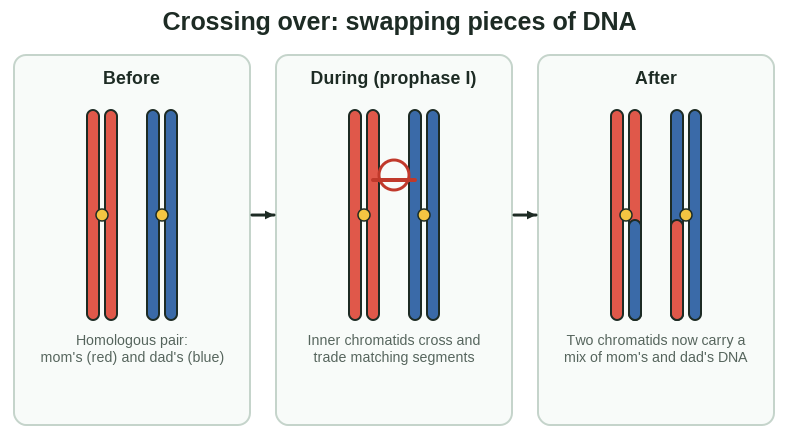
The pieces are the same length and carry the same genes, but possibly different alleles. After the swap, a chromosome carries a mix of alleles from the mother's chromosome and the father's. It's like shuffling two halves of a deck of cards together. The result is a new combination of alleles that didn't exist in either parent.
Crossing over happens at random places, and it happens in every pair, in every meiosis. So even gametes made by the same person are almost never alike.
Independent Assortment
The second source of variety is how the pairs line up in metaphase I. For each pair, which homolog faces which side of the cell is a coin flip. The pairs line up independently of each other.
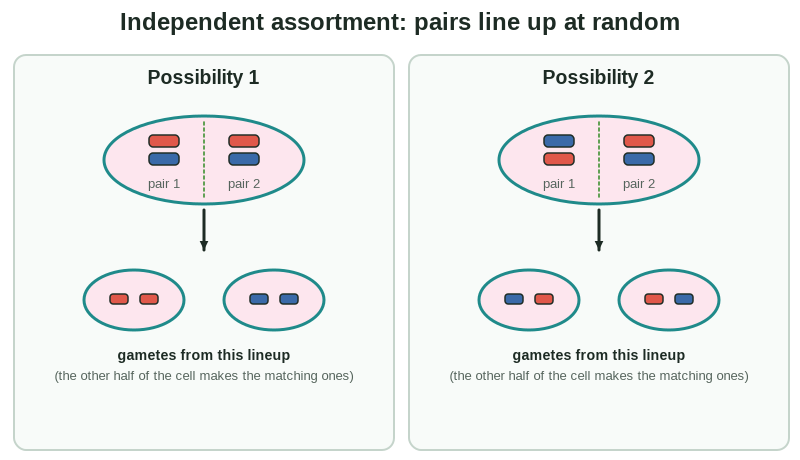
With 2 pairs, there are 4 possible combinations (22). With 3 pairs, 8. Humans have 23 pairs, so there are 223, or more than 8 million, different combinations of chromosomes a person can make, even before crossing over.
Random Fertilization
The third source of variety is which sperm fertilizes which egg. Of the millions of different sperm, only one fertilizes an egg, and that egg is one of many different eggs.

Put the three together, and the number of possible children from one couple is more than 70 trillion. That is why even brothers and sisters differ from each other (except identical twins, who came from a single fertilized egg that split).
Why It Matters
- Siblings differ because each gamete is a unique mix. (Full siblings share, on average, about half of their DNA.)
- Variation within a population gives natural populations raw material for adaptation (Topic 8.3) and gives animal and plant breeders traits to choose from.
- Crossing over helps keep chromosomes from being locked in the same combinations forever.
Worth a Pause
Sturtevant found order in the chromosomes by watching how often traits traveled together. Genesis 1 says living things reproduce "according to their kinds," and meiosis explains how a family can resemble each other and yet have each member be different. Every person is an original combination from the same Source.
In one line: Swap, shuffle, and pair up: no two gametes are alike.
Practice Problems
- What is crossing over? When in meiosis does it happen?
- Why does crossing over create new combinations of alleles?
- What is independent assortment? In which stage does it happen?
- A cell has 3 pairs of chromosomes. How many different combinations can independent assortment produce?
- Name the three sources of genetic variation in sexual reproduction.
- Why do brothers and sisters from the same parents look different?
- Why aren't identical twins different in the same way?
- What did Sturtevant's genetic map show about genes on a chromosome?
View Practice Problem Solutions →
Play to Practice
Try It: Name the shuffles and count the combinations in Family Tree Village: Variation Lab. Play Family Tree Village: Variation Lab »