Topic 7.5: Pedigrees and Probability
Doctors use family trees for more than hobby history. A pedigree can show which relatives might carry a gene, and how likely it is to be passed on. The most famous one in history belonged to a royal family.
Queen Victoria of England (1819-1901) had nine children, and her descendants married into royal families all across Europe. Hidden in that family was a gene for hemophilia, a condition in which blood does not clot properly, so even a small cut or bruise can be dangerous. Victoria herself was a carrier: she didn't have the condition, but she carried one copy of the recessive allele on one of her X chromosomes.
Her son Leopold had hemophilia. Two of her daughters were carriers, and they passed it to royal families in Russia, Spain, and Germany. In Russia, Tsar Nicholas II's son, Alexei, had hemophilia. The family tree made the pattern easy to see, and a drawing of a family tree like that has a name: a pedigree.
Reading a Pedigree
A pedigree is a chart that shows how a trait is passed through a family over several generations.

- Squares are males, circles are females.
- Shaded shapes have the trait; unshaded shapes do not.
- A horizontal line joins a couple. A vertical line leads down to their children.
- Generations are labeled with Roman numerals (I, II, III), and individuals with numbers (II-3).
Clues for Figuring Out the Pattern
- Recessive trait: it can skip generations. Two unaffected parents can have an affected child (both are carriers, Aa × Aa). That is the strongest clue.
- Dominant trait: every affected person has at least one affected parent, and it usually shows up in every generation.
- X-linked recessive: many more males than females are affected, and the trait often passes from grandfather through a carrier daughter to a grandson.
Once you know the pattern, you can work out the likely genotypes: an affected person with a recessive trait is aa. Their unaffected parents must both be Aa (carriers). Their children must all have at least one a.
Probability in Genetics
Every time a gamete forms, which allele it gets is a matter of chance, like flipping a coin. A Punnett square is a tool for working out those chances. A few rules help for more complicated cases:
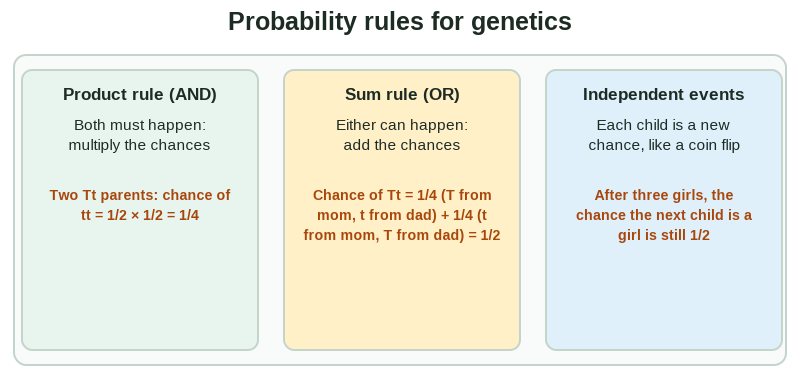
1. Product rule (AND): the chance that two independent events both happen is the product of their chances. Two Tt parents: chance of a tt child = (1/2 that dad passes t) × (1/2 that mom passes t) = 1/4. It's the same as flipping two coins and getting heads both times.
2. Sum rule (OR): the chance that either of two ways happens is the sum. Chance of a Tt child = 1/4 (T from mom, t from dad) + 1/4 (t from mom, T from dad) = 1/2.
3. Independent events: each child is a new chance. The coin has no memory. If a couple has three daughters, the chance that the fourth child is a girl is still 1/2.
Example: Two carriers of cystic fibrosis (Cc × Cc) want to know the chance their child has the disease (cc), is a carrier (Cc), and is unaffected overall:
- Affected (cc): 1/4
- Carrier (Cc): 1/2
- Unaffected (CC or Cc): 3/4
(Because the probability is calculated for each child, a family with a 1-in-4 chance could have no affected children, or all of them.)
Worth a Pause
A pedigree is more than a diagram. It's a record of real people, each loved, and each one unique. In the Bible, genealogies (Matthew 1, Luke 3) show how much God cares about the line of families and the individual names in them. Genetics is about patterns, but every dot on the chart is a person.
In one line: A pedigree turns a family story into probabilities.
Practice Problems
- What do squares, circles, shaded shapes, and horizontal lines mean in a pedigree?
- Two unaffected parents have an affected daughter. Is the trait dominant or recessive? What are the parents' genotypes?
- How can you tell from a pedigree that a trait is dominant?
- Why are X-linked recessive traits more common in males?
- Two heterozygous (Aa) parents have a child. What is the probability the child is aa? Use the product rule.
- Using the sum rule, what is the chance a child of two Aa parents is heterozygous (Aa)?
- A couple has three sons. What is the chance their fourth child is a son? Explain.
- Two carriers of cystic fibrosis have two children. What is the chance both are affected (cc)?
View Practice Problem Solutions →
Play to Practice

Try It: Family Tree Village: Pedigree Detective. Read family trees to work out whether a trait is dominant or recessive, and who carries it. Play »

Try It: Family Tree Village: Odds Lab. Read Punnett squares, use the product and sum rules, and see why chance has no memory. Play »