Topic 7.7: When Meiosis Goes Wrong
Meiosis splits and shuffles chromosomes with amazing accuracy. But once in a while, a pair fails to separate, and an egg or sperm ends up with one chromosome too many or too few. About 1 in 700 babies born in the U.S. has Down syndrome, which comes from an extra copy of chromosome 21. People with Down syndrome are people first, with their own personalities, strengths, and families.
How did anyone figure out the cause? It took almost a century.
In 1866, an English doctor named John Langdon Down described a group of people who shared certain features and a particular kind of developmental disability. For nearly a century, no one knew the cause.
In 1959, a young French doctor and geneticist named Jérôme Lejeune looked at the chromosomes in cells from children with the condition. He counted 47 where there should be 46: an extra copy of chromosome 21. It was the first time a human condition was traced to a chromosome difference.
Lejeune, a devout Christian, spent the rest of his career caring for his patients and their families and defending the worth of every person, including those with Down syndrome. That's the right place to start this topic: people with chromosome differences are people first, made in the image of God (Genesis 1:27), and each one is valuable. Biology gives us the language to understand how these changes occur. It never gives us reason to value anyone less.
Normal Meiosis Usually Works
Meiosis is an amazingly precise process. But with 23 pairs of chromosomes to pull apart in every cell, mistakes happen from time to time. The most common is called nondisjunction.
Nondisjunction
Nondisjunction ("not coming apart") happens when a pair of chromosomes (in meiosis I) or a pair of chromatids (in meiosis II) fails to separate. Both go into the same gamete.
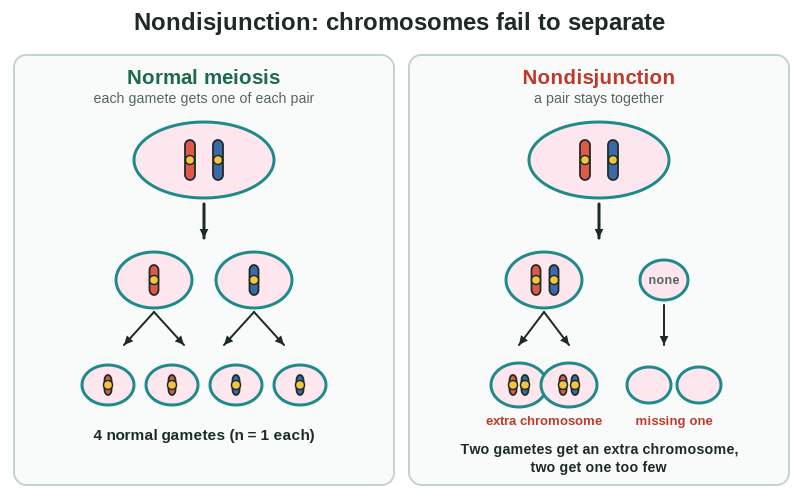
The result: some gametes get one extra chromosome (n + 1) and some are missing one (n − 1). If one of those gametes joins with a normal gamete at fertilization, the zygote has an abnormal chromosome number.
- A zygote with an extra copy of a chromosome is called trisomic (three copies).
- A zygote with only one copy is called monosomic.
Most of these zygotes do not survive. Some do, and they have a recognizable set of features.
Do the arithmetic. A normal egg (23) plus a normal sperm (23) makes 46. An egg carrying an extra chromosome 21 (24) plus a normal sperm (23) makes 47.
Examples in Humans
- Down syndrome (trisomy 21): three copies of chromosome 21 (47 chromosomes in all). It occurs in about 1 in 700 births. People with Down syndrome often have intellectual disability of varying degrees and an increased risk of some health problems, and many live full lives with the support of their families and communities. The chance rises with the mother's age.
- Turner syndrome (monosomy X): a female with only one X (45 chromosomes).
- Klinefelter syndrome (XXY): a male with an extra X (47 chromosomes).
A karyotype is a picture of a person's chromosomes, arranged in pairs by size. It's made from a cell during mitosis, and lets doctors count the chromosomes and spot extra or missing ones.

Changes in Chromosome Structure
Not all errors involve the number of chromosomes. Pieces of chromosomes can be deleted, duplicated, flipped, or moved. A translocation is when a piece of one chromosome breaks off and attaches to a different chromosome.
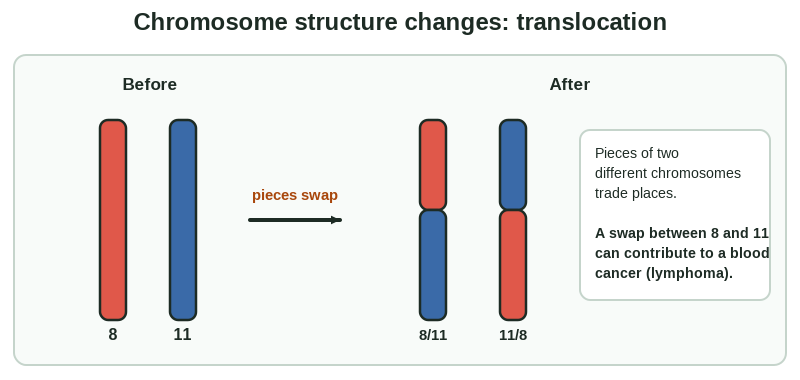
Some translocations are harmless. Others disrupt genes. For example, a translocation between chromosomes 8 and 11 is linked to certain blood cancers, such as lymphoma and a type of myeloproliferative disorder. These are often somatic changes (they occur in a body cell and aren't inherited), though in some cases a translocation can be present in the gametes and passed on.
Mutations and the Environment
Mutations in gametes can also come from the environment. Teratogens are substances that can harm a developing embryo or damage DNA in reproductive cells, such as alcohol, some medications, and radiation. Smoking during pregnancy and certain chemical exposures can alter genes in the reproductive cells or interfere with a baby's development. The expression of traits depends on both the genes we get and the environment they develop in.
Worth a Pause
Psalm 139:13-16 says God knitted each of us together, and the days of our lives were written in his book before any of them came to be. Genesis 1:27 says every person bears his image, no matter what the karyotype looks like. Lejeune's story is a good reminder that studying the biology of chromosomes goes hand in hand with caring for the people who carry them.
In one line: When a chromosome fails to separate, the count changes, and people are people first.
Practice Problems
- Define nondisjunction. In which stage of meiosis can it happen?
- A gamete with an extra chromosome fuses with a normal gamete. How many copies of that chromosome does the zygote have? What is it called?
- How many chromosomes does a person with Down syndrome have? Which chromosome is extra?
- What is a karyotype, and what does it let doctors see?
- Explain what a translocation is. Give an example mentioned in this lesson.
- Why are translocations in body cells not inherited, but changes in gametes can be?
- Name two environmental factors that can harm reproductive cells or fetal development.
- A man has a translocation in his skin cells caused by UV exposure. Can he pass it to his children? Explain.
View Practice Problem Solutions →
Play to Practice
Try It: Count chromosomes in karyotypes in Family Tree Village: Chromosome Count. Play Family Tree Village: Chromosome Count »