Topic 8.3: Natural and Artificial Selection
Gorongosa National Park in Mozambique was home to thousands of elephants. Then, between 1977 and 1992, a civil war tore through the country, and soldiers killed most of the park's elephants for their ivory and meat. About 90% of the elephants were killed. Today the park's elephants are recovering, but scientists noticed something odd about the survivors.
In most African elephant populations, only a small share of females (a few percent) are born without tusks, and before the war about 18% of Gorongosa's females were tuskless. Among the female elephants that survived the war, about half (51%) had no tusks. Researchers who compared the numbers concluded that during the war, tuskless females were far less likely to be killed for ivory, so more of them survived and had calves, and passed the tuskless trait on.

That is a clear, real-life example of natural selection at work, and it was measured within a single human lifetime. The 2023 Alabama standards ask us to analyze data like this to explain how populations change.
Natural Selection: Four Ingredients
Charles Darwin and Alfred Russel Wallace described this idea in the 1850s. It needs four things:
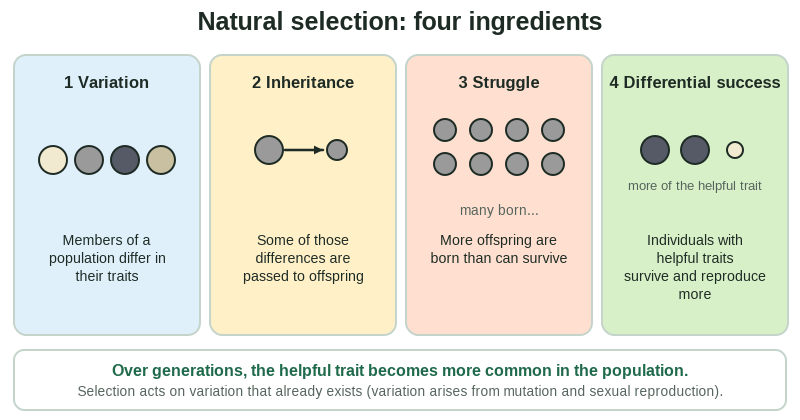
- Variation: individuals in a population differ in their traits.
- Inheritance: some of those differences are passed to offspring (they are genetic).
- Struggle: more offspring are born than can survive, so there is competition.
- Differential success: individuals whose traits fit the environment better tend to survive and have more offspring.
Over generations, helpful traits become more common in the population. An adaptation is a trait that helps an organism survive and reproduce in its environment. Where does the variation come from? New alleles arise from mutations (errors in DNA replication, from Unit 3) and are shuffled by sexual reproduction (Unit 7).
Note what natural selection is not: individuals don't change themselves to fit the environment, and selection doesn't "plan" ahead. It acts on variation that already exists, favoring whatever works well right now.
More Examples You Can Check
Peppered moths. In England before the Industrial Revolution, most peppered moths were pale, matching lichen-covered trees. As factory soot darkened the trees, the dark moths became easier to hide, and the pale ones were eaten more by birds. Dark moths became far more common. When pollution laws cleaned the air, pale moths increased again.

Antibiotic resistance. In a population of bacteria, a rare mutation can let a few survive a drug. When the drug kills the others, the survivors multiply. Some bacteria can double every 20 minutes. In just 8 hours that is 24 doublings, from one cell to over 16 million, so a rare resistant survivor can take over fast. Over several rounds, the population becomes mostly resistant. This is why doctors ask you to finish your prescription and not take antibiotics when you don't need them.

Artificial Selection
In artificial selection (or selective breeding), people choose which individuals reproduce, based on traits they want. We've been doing it for thousands of years.
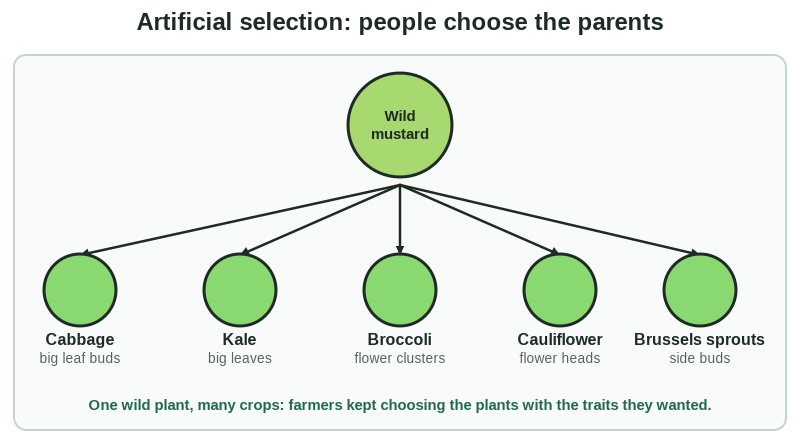
The wild mustard plant has been bred into cabbage, kale, broccoli, cauliflower, and Brussels sprouts, depending on which part farmers favored. Corn came from a grass called teosinte with only a few hard kernels. Dog breeds, from Chihuahuas to Great Danes, are all the same species.
Another Way to Read the Evidence
Natural selection itself is not the point of disagreement. Creation scientists agree that selection happens: they point to the same moths, the same bacteria, and the same breeds of dog as examples of variation and adaptation within created kinds, a process that can only choose among traits already present or sort and lose genetic information. The disagreement is about how far the process reaches: whether the same mechanism, running over millions of years, can account for the origin of new body plans and all of the diversity of life. The theory says yes; many Christians say the evidence doesn't support that extrapolation. As a student, you can master what is observed (and tested) separately from what is inferred.
Please note the standards do not ask us to cover other mechanisms such as genetic drift or gene flow, and we don't need allele-frequency math. The focus is on using data to explain selection.
Worth a Pause
Elephants without tusks are a reminder that creatures live within real pressures, and that people can influence them for good or ill. Genesis 1:28 gave humans a role of ruling the earth as caretakers. Whether we shape a crop for the harvest or we drive a species toward a lopsided survival, our actions have consequences for living things.
In one line: People choose or nature chooses, and the traits that fit are the ones that stay.
Practice Problems
- List the four ingredients needed for natural selection.
- Define adaptation. Where does new variation in a population come from?
- Use the elephant data: what percent of females lacked tusks before the war, and among the survivors? Explain the change in terms of selection.
- In the peppered moth example, what was the selecting factor? What happened to the moth population when the trees darkened?
- A bacterial population is treated with antibiotic A repeatedly. Explain why the percentage of resistant bacteria goes up.
- What is artificial selection? Name two examples.
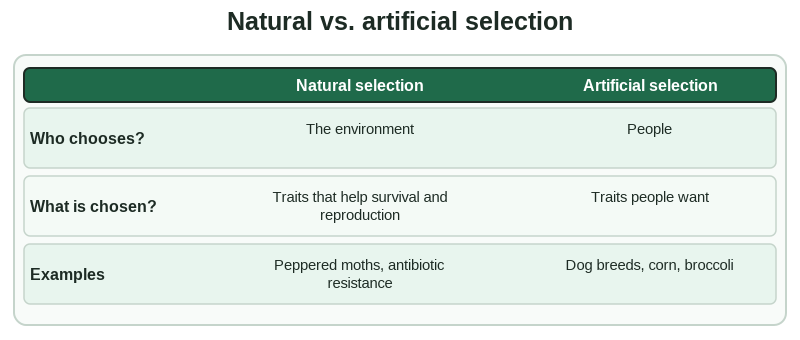
- Compare natural and artificial selection: who or what does the selecting?
- A student says, "The bacteria changed themselves to become resistant." Correct this using what you know about variation and selection.
View Practice Problem Solutions →
Play to Practice

Try It: Tree of Life: Selection Lab. Four ingredients of natural selection, reading before-and-after data, and natural vs. artificial selection. Play »

Try It: Tree of Life: Selection Station. Read the graphs: how do traits change in moths, bacteria, and elephants, and what is artificial selection? Play »