Topic 1.1: Life's Building Blocks: Four Kinds of Molecules Build Everything Alive
You are made mostly of four elements: oxygen, carbon, hydrogen, and nitrogen, which add up to about 96% of your body's mass. None of them is alive. So what makes a living thing different from a pile of the same stuff?
For a long time, people were sure the answer was a special "life force" that only living things had, and that chemistry could never make the molecules of life on its own. One unexpected result in a German lab in 1828 started to crack that idea.
In 1828, a German chemist named Friedrich Wöhler was heating up a chemical called ammonium cyanate, a plain old lab chemical that had never been inside a living thing. When it cooled, he found crystals of something he recognized: urea, the waste molecule found in urine. He wrote to his teacher, the famous chemist Berzelius, that he could make urea without a kidney, or even an animal.
Yes, that is the first time anyone made pee in a lab. And at the time it was a big deal, because many people believed the molecules of life could only be made by living things, using some special "vital force." A short lab experiment suggested that maybe living things are made of the same stuff as everything else.
(A quick honesty note: the story that Wöhler "killed" that old idea in a single afternoon is mostly a legend, and historians say chemists were already doubting it. But his experiment is still a great reminder of what we learn in this topic: life is built from ordinary atoms, put together in extraordinary ways.)
The Six Main Ingredients
Nearly everything alive is built from just six kinds of atoms. Memorize the nickname CHNOPS: Carbon, Hydrogen, Nitrogen, Oxygen, Phosphorus, and Sulfur.

Why Carbon Is the Star
Carbon can form four bonds with other atoms. That one fact is a big deal. It means carbon can link to other carbons and build long chains, branches, and rings, the frames that big molecules are built on. A chain of 6 atoms can look very different from a ring of 6, even though they use the same ingredients.
Here's the proof: the diamond in a ring and the graphite in your pencil are both pure carbon. Same atoms, wildly different stuff (one is the hardest natural material, the other is soft enough to smear on paper), because the atoms are connected in different patterns.

Monomers and Polymers
Living things build big molecules by connecting many small ones, like a bead necklace. A single bead is a monomer. The whole necklace is a polymer. And the very large molecules cells are built from are called macromolecules.
Think of snapping LEGO bricks together. The cell does the same thing with a reaction called dehydration synthesis. As the name hints, a water molecule (H₂O) is removed each time two monomers connect. To take a polymer apart, the cell does the reverse, hydrolysis, which uses a water molecule to split the connection. (Digesting your lunch is hydrolysis in action.)

The Four Macromolecules
Every living thing, from a bacterium to a blue whale, uses the same four families:
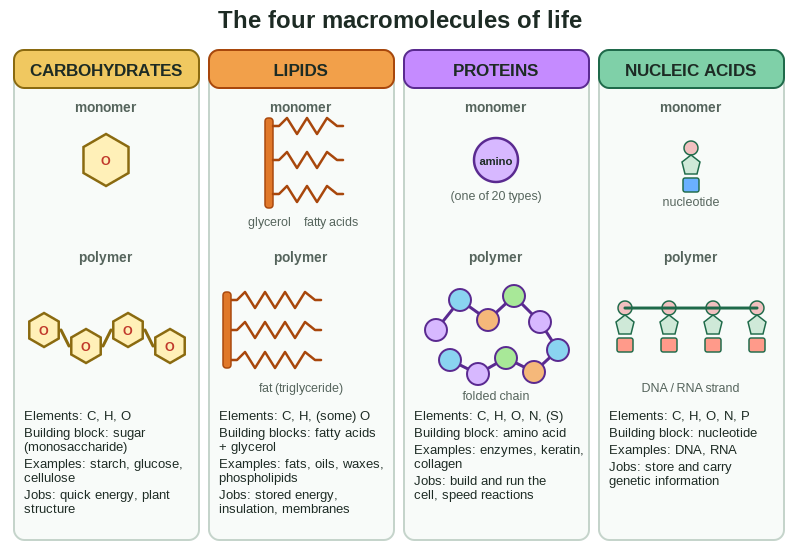
- Carbohydrates give quick energy and build some structures (like plant cell walls). Simple sugars such as glucose join to make starch and cellulose.
- Lipids (fats, oils, waxes, and the phospholipids in cell membranes) store lots of energy, insulate the body, and form membranes. Lipids are a little different: they are built from fatty acids and glycerol and are not long chains of one repeating unit, but they are still considered a macromolecule family. Gram for gram, fat holds about twice the energy of carbohydrate (about 9 Calories per gram versus 4).
- Proteins are the workers of the cell. Chains of amino acids fold into shapes that build structures, move things, and run chemical reactions as enzymes. There are 20 amino acids, and a nearly endless number of possible proteins. How endless? A chain of just 100 amino acids can be put together in 20 × 20 × 20 … (100 times) different orders. That number has 131 digits, far more than the number of atoms in the universe.
- Nucleic acids (DNA and RNA) store and carry the instructions for making proteins. Their monomers are nucleotides.
Where you meet them at lunch: bread and pasta are mostly carbohydrates, olive oil and butter are lipids, and eggs, chicken, and beans are rich in proteins. Nucleic acids are in everything you eat, because every cell you eat has DNA.
Worth a Pause
Think about how little this takes. Six kinds of atoms, four families of molecules, one set of building rules, and out come grass, goldfish, and grandmothers. The Psalmist put it this way: "O LORD, how manifold are thy works! in wisdom hast thou made them all" (Psalm 104:24). The deeper we look, the more that sounds like a fair summary.
In one line: Same few atoms, four families of molecules, and out comes everything alive.
Practice Problems
- What does the nickname CHNOPS stand for? Which three of those elements are found in all four macromolecules?
- Why is carbon so useful for building large molecules?
- Define monomer and polymer. Give the monomer for each of the four macromolecules.
- Which process releases a water molecule when two monomers join: dehydration synthesis or hydrolysis? Which one uses water to break a polymer apart?
- Name the macromolecule that is the main component of each: (a) bread (b) olive oil (c) egg white (d) the DNA in your cheek cells.
- A snack has 10 g of fat and 10 g of carbohydrate. Which gives your body more energy per gram?
- Which macromolecule's monomers always contain phosphorus?
- What did Wöhler's urea experiment show about the molecules found in living things?
View Practice Problem Solutions →
Play to Practice

Try It: Test your sorting skills in Cell City: Macromolecule Match. Play Cell City: Macromolecule Match »