Topic 2.4: Proteins at Work and How Genes Are Controlled
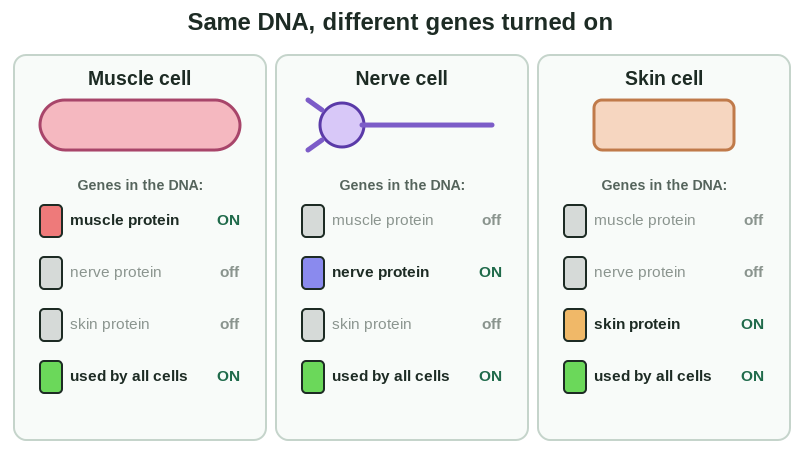
Every cell in your body has the same DNA. Yet a brain cell and a muscle cell look nothing alike and do completely different jobs. The difference is which genes are switched on.
And sometimes a single changed letter in a single gene is enough to reshape a protein, and with it an entire red blood cell. That is exactly what scientists realized about sickle cell disease.
In 1949, the famous chemist Linus Pauling and his team showed that the hemoglobin in the red blood cells of people with sickle cell disease behaves differently from normal hemoglobin. They called it a "molecular disease," the first time anyone suggested that a disease could trace back to a single molecule.
In 1956, a biochemist named Vernon Ingram found out exactly how it differed. Out of the roughly 146 amino acids in each chain of hemoglobin, only one was different. In normal hemoglobin, position 6 holds glutamic acid; in sickle cell hemoglobin it holds valine. One building block out of 146, and the whole molecule behaves differently.
That's the theme of this topic: proteins do the work, and tiny changes in the code can change the work.
Proteins Are the Workers
Remember from Topic 1.1 that proteins are chains of amino acids. A cell makes thousands of different ones, and they carry out most of the work of life. Alabama's biology standard singles out four jobs:
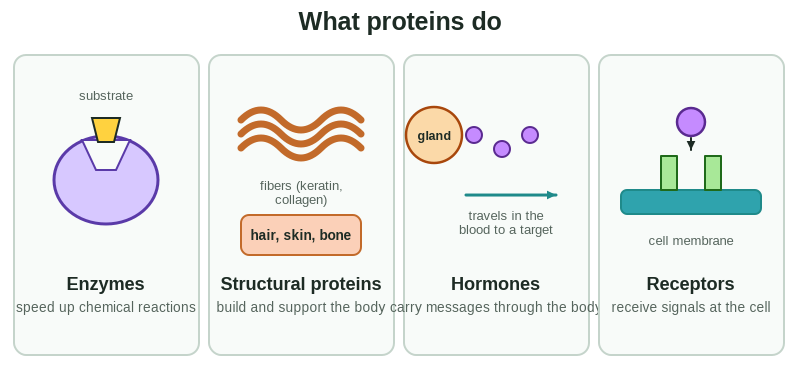
- Enzymes speed up chemical reactions (digestive enzymes break down food; others copy DNA).
- Structural proteins build and support the body (keratin in hair and nails, collagen in skin and bones).
- Hormones are chemical messengers sent through the blood (insulin tells cells to take in sugar).
- Receptors sit on or in a cell and receive signals, such as a hormone arriving.
Shape Is Everything
A chain of amino acids doesn't stay a straight line. It folds into a specific three-dimensional shape, and that shape decides what the protein can do. An enzyme's folded shape has a pocket that fits one particular molecule, like a key in a lock. Change the sequence of amino acids, and the folding can change; change the folding, and the protein may not work. Cook an egg and you can watch this happen: the clear egg white turns solid white because its proteins unfold and tangle. Same protein, different shape, completely different behavior.
When the Code Changes: Mutations
A mutation is a change in the DNA sequence. Some mutations have no effect. Some harm. A few help. In sickle cell disease, one DNA base changes (GAG becomes GTG), so the mRNA codon changes (GAG to GUG), and the amino acid in the protein changes (glutamic acid to valine). That is one letter changed out of about 3 billion.
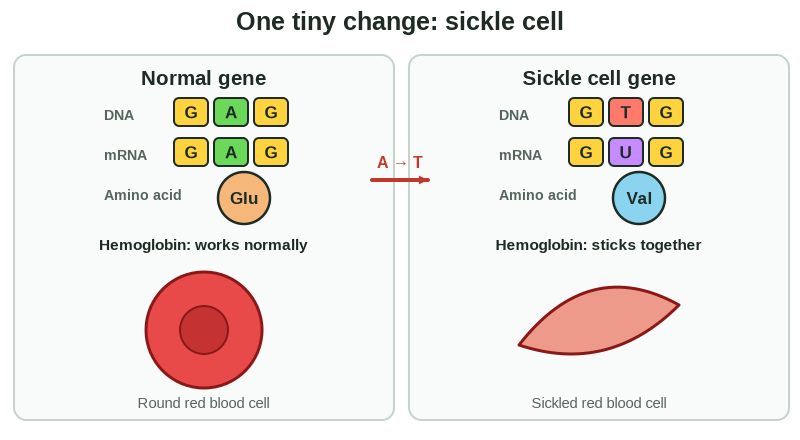
That single substitution makes hemoglobin molecules stick together when oxygen is low, bending red blood cells into a sickle shape that can block small blood vessels. (Interestingly, people who carry just one copy of the sickle gene are more resistant to malaria, which helps explain why the gene is common in parts of the world where malaria is common.)
Every Cell Has All the Genes, but Not All Are On
Here's a puzzle. Your muscle cells, nerve cells, and skin cells all contain the same DNA, the same 20,000 or so genes. So how can they be so different? The answer is gene expression: each type of cell turns on a different set of genes, and keeps the rest off. A muscle cell makes lots of muscle proteins. A nerve cell makes nerve proteins. This process of becoming a specialized cell is called differentiation. Think of two phones with the same apps installed but different home screens. Every cell has all the apps (genes). It just opens a different few.
How Does a Cell Switch Genes On and Off?
Cells use several kinds of controls. Here are three the Alabama standard mentions:
- Transcription factors are proteins that bind to a gene's control region and help RNA polymerase start (or keep it from starting).
- Chromatin structure: DNA wrapped tightly around histones is hard to reach, and the gene is "off." Chemical changes to histones or DNA can loosen it so that the gene can be read.
- Non-coding DNA: Much of our DNA doesn't code for a protein. Some of it contains control regions, "switches" that tell nearby genes when to turn on.
RNA also helps. Beyond mRNA, tRNA, and rRNA, cells make small regulatory RNAs that can help switch genes on and off.

Worth a Pause
From one cell, a fertilized egg, you grew into a body with over two hundred kinds of cells, each one in the right place making the right proteins. That is a staggering amount of coordination. The Psalmist put it simply: "Thine eyes did see my substance, yet being unperfect; and in thy book all my members were written" (Psalm 139:16).
In one line: Same DNA, different switches, different cells.
Practice Problems
- Name the four protein jobs from this lesson and give one example of each.
- Why does the shape of a protein matter? What determines the shape?
- What is a mutation? Describe the mutation that causes sickle cell disease, from the DNA base all the way to the amino acid.
- A DNA change turns the codon CAG (Gln) into CAA. Will the protein change? Explain, using the code table.
- All the cells in your body have the same DNA. How can a muscle cell and a nerve cell be so different?
- What is gene expression? What is differentiation?
- Name three ways a cell can control whether a gene is on or off.
- A scientist finds a gene that is "off" in skin cells and "on" in liver cells. What are two things that could explain the difference?
View Practice Problem Solutions →
Play to Practice

Try It: Practice reading and writing the code in Code Library: DNA Decoder. Play Code Library: DNA Decoder »