Topic 4.3: Passive Transport: Diffusion and Osmosis
Put one drop of food coloring into a glass of still water. Don't stir it. Nobody pushes it, and nothing carries it, and yet the color slowly spreads until the whole glass is evenly tinted. Walk into a kitchen where cookies are baking and you can smell them from the doorway: same thing.
Cells use that same free spreading to move things across their membranes, and it costs them zero energy. That's passive transport. The engine behind it was first spotted by accident, in a drop of water with some pollen in it.
In 1827, a Scottish botanist named Robert Brown was looking through his microscope at pollen grains floating in water. To his surprise, the tiny grains kept jiggling and darting around, even though nothing seemed to be touching them. He first wondered if the pollen was alive. But dust and other lifeless particles did the same thing.
The explanation came much later: water molecules are always moving and bumping into the grains from every side. Everything in a liquid or gas, at room temperature, is in constant random motion. That motion is the engine behind our topic today.
Moving Without Spending Energy
Cells have two ways of moving substances across the membrane:
- Passive transport needs no energy from the cell. Substances move down their concentration gradient (from where there's more to where there's less).
- Active transport needs energy from the cell (next topic).
A concentration gradient is a difference in concentration between two places. Think of a crowded room next to an empty hallway: people will naturally spread out into the empty space without anyone pushing them. Passive transport is like that.
Diffusion
Diffusion is the movement of particles from an area of higher concentration to an area of lower concentration. Because the particles are always moving randomly, more of them travel from the crowded area to the empty one than the other way around, until they are evenly spread out. That's called equilibrium. At equilibrium the particles are still moving, but there's no net change.
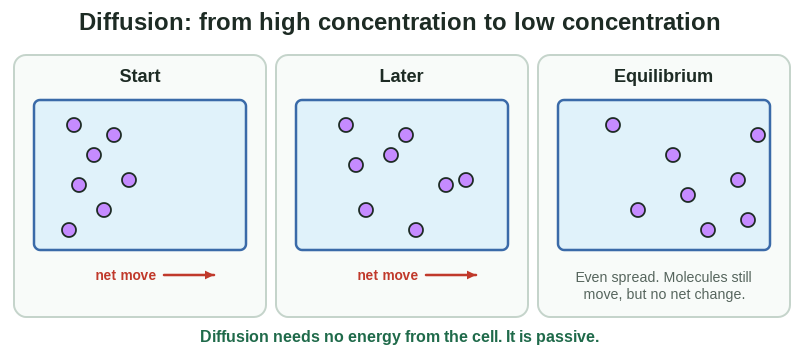
Your cells use diffusion all the time. Oxygen is at a higher concentration in your blood than inside your cells, so it diffuses in. Carbon dioxide builds up inside cells, so it diffuses out. Small nonpolar molecules like these slip right through the lipid bilayer.
Facilitated Diffusion
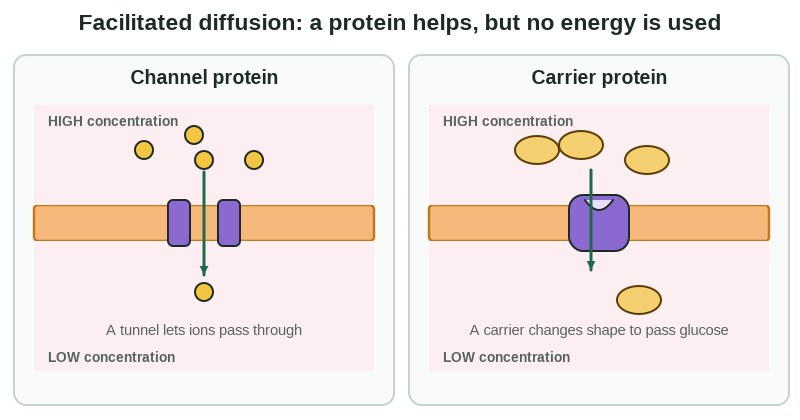
What about molecules that can't cross the lipid bilayer, like glucose or ions? They can still move down their gradient with help from a channel protein or carrier protein. This is facilitated diffusion. It's still passive: no energy is spent, because the substance is moving downhill. The protein just opens the door.
Osmosis: Diffusion of Water
Osmosis is the diffusion of water across a selectively permeable membrane. Water moves toward the side with the higher solute concentration (the side with more dissolved stuff, and therefore relatively less free water).
The French scientist Jean-Antoine Nollet noticed this in 1748. He sealed alcohol in a pig's bladder and soaked it in water. The bladder swelled up as water flowed in.
What happens to a cell depends on the solution around it:

- Hypotonic solution (less solute outside): water moves in. An animal cell swells and may burst; a plant cell becomes firm (turgid), which is exactly what a plant wants, since turgor pressure holds it up.
- Isotonic solution (equal solute): no net movement. An animal cell stays normal.
- Hypertonic solution (more solute outside): water moves out. An animal cell shrivels, and a plant cell's membrane pulls away from its wall (plasmolysis), so the plant wilts.
A memory trick: hypo means "under," so the solute concentration is under the cell's. Hyper means "over."
This is why you shouldn't drink seawater: it's hypertonic compared to your cells, so it pulls water out of them. And it's why salt kills weeds in a driveway crack: water rushes out of their cells. It's also why a wilted lettuce crisps up in cold tap water, and why strawberries sprinkled with sugar turn juicy as water is pulled out of them.
Worth a Pause
A cell wall, a membrane, and a gradient: no pumps, no fuel, and yet water goes where it's needed. Even something as simple as diffusion is a design built into the way matter works.
In one line: Downhill costs nothing: molecules just spread out.
Practice Problems
- Define diffusion. Which way do particles move relative to the concentration gradient?
- Why doesn't diffusion require energy from the cell?
- What is equilibrium? Do the particles stop moving at equilibrium?
- Oxygen is higher outside a cell than inside. Which way does it diffuse, and does it need a protein?
- How is facilitated diffusion different from simple diffusion? Is it active or passive?
- Define osmosis. Which way does water move?
- A red blood cell is placed in pure water. Predict what happens and explain using the word hypotonic.
- A wilted plant is watered. Explain what happens inside the cells using osmosis.
View Practice Problem Solutions →
Play to Practice

Try It: Membrane Gate: Tonicity Lab. Predict which way water moves and what happens to animal and plant cells in different solutions. Play »

Try It: Membrane Gate: Cell Transport. Diffusion, facilitated diffusion, osmosis, or active transport? Read the membrane and decide. Play »