Topic 4.4: Active Transport: Pumping Uphill
Think of pushing a boulder up a hill. It takes real effort, because you are working against the slope. Cells do the same thing constantly, moving particles from where there are few to where there are already lots. It costs ATP, and a big slice of the energy your body burns even when you're sitting still goes to it.
The machines that do the pushing are called pumps, and the first one was found in the nerves of a crab.
In the 1950s, a Danish doctor and scientist named Jens Christian Skou was studying the nerves of shore crabs. He noticed an enzyme in the nerve membranes that used ATP, but only when both sodium and potassium were around. It turned out to be a pump: a protein that burns ATP to push ions across the membrane. In 1997 he received the Nobel Prize in Chemistry for the discovery.
The discovery solved a puzzle. Cells keep a lot more potassium inside and a lot more sodium outside than you'd expect from diffusion alone. Something had to be working against the flow. That something is active transport.
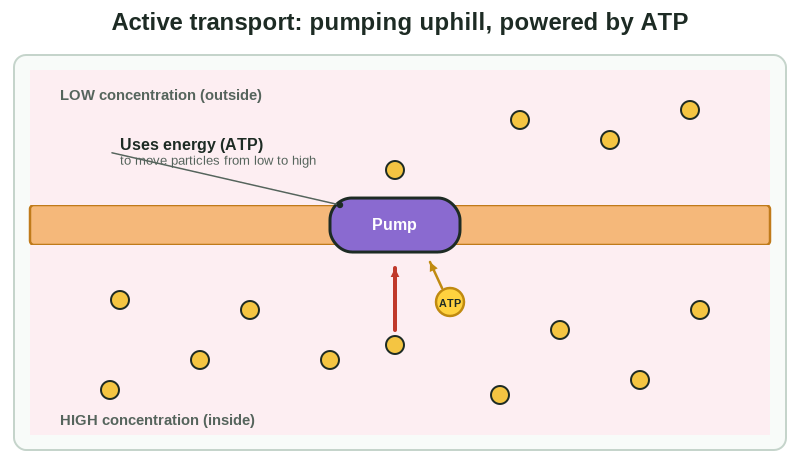
Uphill Takes Energy
Passive transport moves substances down their concentration gradient. But cells often need to move things the other way: from low to high concentration. That's like pushing a ball uphill, and it takes work. In a cell, that work is done by ATP, the energy molecule you met in Unit 1.
Active transport moves substances against their concentration gradient, using energy (ATP) and a protein pump.
The Sodium-Potassium Pump
The most famous pump is the sodium-potassium pump. In every cycle it:
- Binds 3 sodium ions (Na+) from inside the cell,
- Uses ATP to change shape,
- Releases the sodium outside, and picks up 2 potassium ions (K+) from outside,
- Returns to its original shape, releasing the potassium inside.
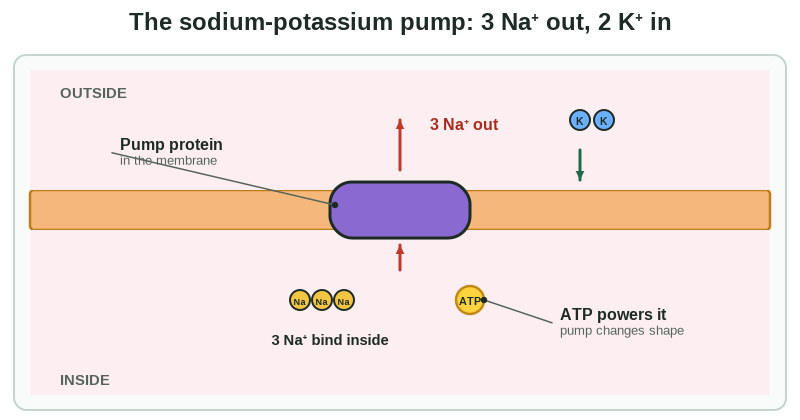
Notice the count: 3 sodium ions go out for every 2 potassium ions that come in. Each cycle sends out one more positive charge than it brings in, which helps keep the inside of the cell slightly negative.
Your nerve cells depend on this pump to be ready to send signals. The pump uses a large share of the energy your body burns even while you're resting.
Moving Big Cargo: Endocytosis and Exocytosis
Some things are too big to fit through any protein, like whole proteins or even bacteria. The cell handles them with vesicles (little bubbles of membrane):
- Endocytosis: the membrane folds inward around the cargo and pinches off a vesicle inside the cell, a bit like a cell version of Pac-Man gobbling a pellet. White blood cells use this to swallow bacteria.
- Exocytosis: a vesicle inside the cell fuses with the membrane and dumps its contents outside. Cells use this to release hormones, wastes, and nerve signals.
Both take energy, so both are forms of active transport.

Active Transport in Your Kidneys
Your kidneys filter about 180 liters of fluid out of your blood each day, and almost all of it has to be taken back. Glucose, for example, must be pulled back into the blood even though the blood already has plenty. That is against the concentration gradient, so the kidney cells use active transport to do it. What's left (extra water, salts, and wastes) becomes urine. Active transport is a big reason you don't lose all your sugar and salt every time you use the restroom.
Passive vs. Active at a Glance

Worth a Pause
Every second, billions of tiny pumps in your body are working, mostly without your noticing. "In Him all things hold together" (Colossians 1:17) is about much more than biology, but it's hard not to think of it when you see how many moving parts have to hold together just for a single nerve cell to be ready.
In one line: Uphill costs ATP.
Practice Problems
- What is the main difference between active and passive transport?
- What provides the energy for active transport?
- A cell has more sodium outside than inside. It needs to move more sodium out. Is that active or passive? Explain.
- Describe what the sodium-potassium pump does in one cycle.
- Why are protein pumps necessary in cell membranes? Why can't the cell just rely on diffusion?
- Compare endocytosis and exocytosis.
- How do your kidneys use active transport to keep glucose in your body?
- Classify each as passive or active: (a) oxygen entering a cell, (b) sodium pumped out, (c) glucose entering through a carrier from high to low concentration, (d) a white blood cell engulfing a bacterium.
View Practice Problem Solutions →
Play to Practice

Try It: Membrane Gate: Pump or Passive. Sort real situations into diffusion, facilitated diffusion, osmosis, active transport, and vesicle transport. Play »

Try It: Membrane Gate: Cell Transport. Diffusion, facilitated diffusion, osmosis, or active transport? Read the membrane and decide. Play »