Topic 5.3: Photosynthesis: Turning Sunlight Into Food
Where does a giant oak tree get its mass? Most people say, "from the soil." It's a very natural guess, and it's wrong. Most of a tree's dry weight is carbon that was floating in the air as carbon dioxide.
That is a strange idea: a tree is, in large part, built out of air. A Belgian physician tested it with a pot, a willow, and five years of patience.
In the 1640s, a Belgian physician named Jan van Helmont planted a 5-pound willow tree in a big pot with exactly 200 pounds of dried soil. He covered the pot so no dust could get in, and for five years he gave the tree nothing but rainwater. When he weighed everything again, the tree was 169 pounds, but the soil had lost only about 2 ounces.
Where did 164 extra pounds of tree come from? Van Helmont concluded that it must have come from the water. He was partly right. We now know that most of a plant's mass comes from something even more surprising: carbon dioxide from the air.
About a century later, an English minister and scientist named Joseph Priestley found another piece of the puzzle. In 1771 he put a lit candle in a sealed jar, and it went out. He put a mouse in a sealed jar, and it soon struggled. But when he put a sprig of mint in the jar, the air was "restored," and a candle could burn again. Plants were doing something that renewed the air. We call that something oxygen.
Put together, the clues point to photosynthesis.
What Is Photosynthesis?
Photosynthesis is the process that converts light energy into chemical energy stored in the bonds of sugar. It happens in plants, algae, and some bacteria. Photo means "light" and synthesis means "putting together."
The ingredients (reactants) and the products are all you need to know to model it:
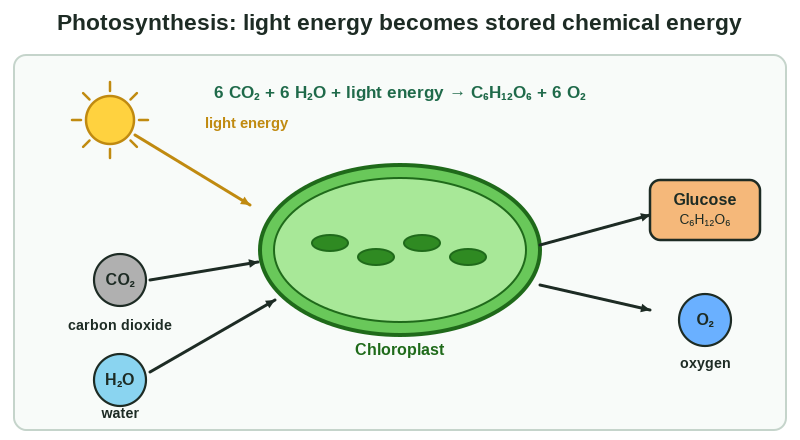
Word equation: carbon dioxide + water + light energy → glucose + oxygen
Chemical equation: 6 CO2 + 6 H2O + light energy → C6H12O6 + 6 O2
- Reactants: CO2 (from the air) and H2O (from the soil).
- Energy source: light, usually from the Sun.
- Products: glucose (a sugar that stores the energy in its bonds) and O2 (released into the air).
Light energy is converted into chemical energy stored in glucose. The plant uses that glucose for its own energy, builds it into starch and cellulose, and stores it. The oxygen is released, which is the "restored air" Priestley saw.
Where It Happens
In plants, photosynthesis happens mostly in the leaves, inside organelles called chloroplasts. Chloroplasts contain a green pigment, chlorophyll, which absorbs light (mostly red and blue light, and reflects green, which is why leaves look green). In autumn the chlorophyll breaks down, and the yellow and orange pigments that were hiding underneath finally show.
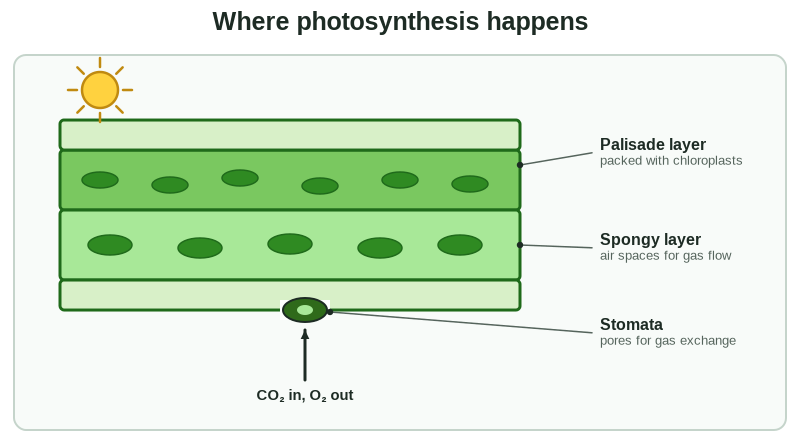
- Stomata (singular: stoma) are tiny pores, mostly on the underside of a leaf. CO2 goes in and O2 goes out through them. Guard cells open and close them.
- Roots take up water, and xylem (Topic 4.1) carries it to the leaves.
Photosynthesis has two stages inside the chloroplast: one that captures light energy, and one that uses that energy to build sugar. You don't need the detailed steps. The big idea is the model above: inputs in, light energy converted, sugar and oxygen out.
What Affects Photosynthesis?
Scientists measure the rate of photosynthesis by counting oxygen bubbles or tracking CO2 use. The rate goes up with more light and more CO2, up to a limit, and it needs water and a good temperature (too hot, and the enzymes involved denature).
Worth a Pause
Every bite of food you've ever eaten is, if you trace it back, sunlight caught by a leaf. A willow tree grows 164 pounds out of air and water and light. Psalm 104:14 says God "makes grass grow for the livestock and plants for man to cultivate, that he may bring forth food from the earth." Photosynthesis is how.
In one line: A tree is built mostly out of air, water, and light.
Practice Problems
- Define photosynthesis in one sentence. Where does it happen in a plant cell?
- List the reactants and products of photosynthesis.
- What form of energy goes in, and what form of energy is stored in the products?
- What is the job of chlorophyll? Why are leaves green?
- How do the reactants get into a leaf? How does oxygen leave?
- Van Helmont's willow gained 164 pounds but the soil lost only about 2 ounces. What do we now know about where most of the mass came from?
- In Priestley's experiment, why did a plant "restore" the air?
- A plant is kept in the dark for a week. Predict what happens to its glucose production, and explain.
View Practice Problem Solutions →
Play to Practice
Try It: Power Plants: Leaf Lab. Explore the parts of a leaf, what photosynthesis takes in and gives out, and what limits its rate. Play »
Try It: Power Plants: Energy Swap. Photosynthesis, cellular respiration, or both? Follow the energy loop between chloroplast and mitochondrion. Play »