Topic 5.4: Cellular Respiration: Releasing the Energy
You breathe about twenty thousand times a day. Why? Because your cells are burning food, and burning needs oxygen. The carbon dioxide you breathe out is the exhaust, and some of those carbon atoms were in your last meal.
Someone worked this out in the 1780s with a guinea pig and a bucket of ice.
In the 1780s, the French chemist Antoine Lavoisier and his colleague Pierre-Simon Laplace wanted to know what was going on when an animal breathes. They put a guinea pig inside a chamber surrounded by ice. As the animal lived, it gave off heat, and the heat melted the ice. They measured the melted water and compared the heat to what they got from burning carbon to make the same amount of carbon dioxide.
The conclusion was startling: respiration is a kind of slow burning. The animal takes in oxygen, "burns" its food, and gives off carbon dioxide and heat, just like a flame does, only far more gently and in a form the body can use.
(Lavoisier was one of the founders of modern chemistry. He lost his head in the French Revolution, but his careful measuring changed science for good.)
What Is Cellular Respiration?
Don't confuse breathing with cellular respiration. Breathing is how oxygen gets into your body and carbon dioxide gets out. Cellular respiration is what happens in your cells: the process that breaks down glucose (and other fuels like fats) to make ATP, the cell's energy currency from Topic 5.1.
In Topic 5.2 we saw that glucose stores energy in its bonds. Cellular respiration breaks those bonds and captures the released energy in ATP. Some of the energy is lost as heat, which is how your body stays warm.
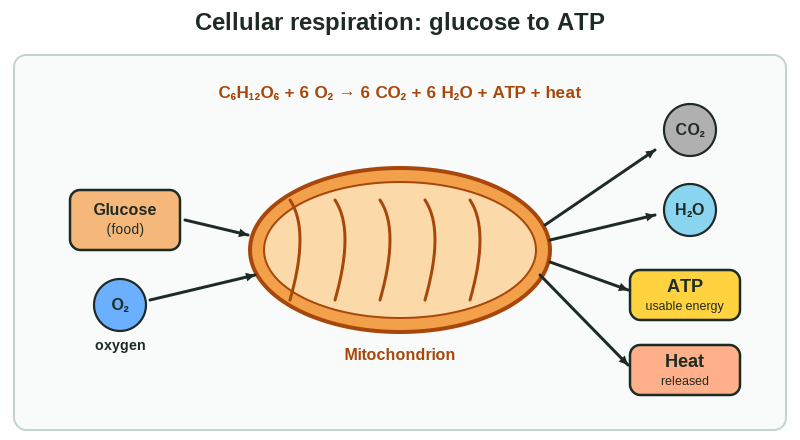
Word equation: glucose + oxygen → carbon dioxide + water + ATP + heat
Chemical equation: C6H12O6 + 6 O2 → 6 CO2 + 6 H2O + ATP + heat
Compare it to photosynthesis in Topic 5.3. It's almost the same equation, backwards. One stores energy in sugar; the other releases it.
Cellular respiration happens in all cells: plant cells, animal cells, fungi, and even bacteria. It starts in the cytoplasm and finishes in the mitochondria of eukaryotic cells, which is why the mitochondria are called the "powerhouses." (You do not need to memorize the individual steps.)
With Oxygen and Without
When oxygen is available, cells use aerobic respiration, which breaks glucose down completely and makes a lot of ATP.
When oxygen is scarce, some cells can still get a small amount of energy using anaerobic respiration (also called fermentation). It only partly breaks down glucose, so it makes much less ATP, but it works without oxygen.

- In your muscles: during a hard sprint, your muscle cells can't get oxygen fast enough. They switch to fermentation, which makes lactic acid along with a quick burst of ATP. The burn you feel is partly from this, and when you rest and breathe hard, you are "paying back" the oxygen.
- In yeast: yeast cells ferment sugar into alcohol and carbon dioxide. The carbon dioxide bubbles make bread rise (the alcohol bakes off), and the same process makes other fermented foods and drinks.
- In bacteria: some bacteria ferment milk sugar into lactic acid, which gives us yogurt.
Fermentation is a backup, and a poor one: it makes only about 2 ATP for each glucose, compared to about 30 or more with oxygen. That's why endurance athletes train their bodies to deliver more oxygen to their muscles.
Respiration Also Runs on Fats
Glucose isn't the only fuel. Cells can break down fats (the 9 Calories per gram from Topic 5.2) and even proteins. Fats release more energy per gram, which is what your body leans on during a long hike or an overnight fast. The idea is the same: break chemical bonds, capture the energy as ATP, release heat.
Here's a surprise. When a person loses body fat, about 84% of it leaves as carbon dioxide that they breathe out, and the other 16% leaves as water. You literally breathe fat away.
Worth a Pause
Your body keeps running at about 37 °C, in the middle of a cold winter, using the energy locked into last night's supper. All of it traces back to a leaf catching light. The Bible says the Lord "gives to all mankind life and breath and everything" (Acts 17:25). Each breath you take is the first step in a chain that ends at your mitochondria.
In one line: Breathe in oxygen, burn food, breathe out carbon dioxide.
Practice Problems
- What is the difference between breathing and cellular respiration?
- Write the word equation for cellular respiration.
- What are the energy-containing products of cellular respiration? What happens to the heat?
- Where does cellular respiration take place in a eukaryotic cell? Do plants do it?
- Compare aerobic and anaerobic respiration: oxygen needed, ATP made, and one example of each.
- Why do your muscles burn during a sprint?
- How does yeast make bread rise?
- Compare the equations for photosynthesis and cellular respiration. What do you notice?
View Practice Problem Solutions →
Play to Practice
Try It: Power Plants: Oxygen or Not. Decide when cells use aerobic or anaerobic respiration and compare how much ATP each makes. Play »
Try It: Power Plants: Energy Swap. Photosynthesis, cellular respiration, or both? Follow the energy loop between chloroplast and mitochondrion. Play »