Topic 6.2: Energy Flow: Food Chains, Food Webs, and the 10% Rule
Why are there so many zebras and so few lions? It is a matter of math, and it is called the ten percent rule. Each step up a food chain keeps only about a tenth of the energy from the step below.
One scientist worked this out by studying a single small lake in great detail.
In the late 1930s, a young ecologist named Raymond Lindeman spent his time at Cedar Bog Lake in Minnesota, studying one small lake in great detail. He didn't just list the plants and animals. He asked a different question: how much energy moves from one kind of organism to the next? He measured the energy captured by algae, then the energy in the animals that ate the algae, then the animals that ate those animals.
His 1942 paper, published after his early death at age 27, showed that only a small fraction of the energy moves up at each step, roughly 10%. The idea of the "10% rule" became one of the foundations of ecology.
Producers, Consumers, Decomposers
Every ecosystem runs on energy that came from the Sun (or, in a few places like deep-sea vents, from chemicals). The living things in it play different roles:
- Producers (autotrophs) make their own food, usually by photosynthesis: grass, trees, algae.
- Consumers (heterotrophs) eat other organisms. Primary consumers (herbivores) eat producers; secondary consumers eat herbivores; tertiary or top consumers eat other carnivores.
- Decomposers (fungi and bacteria) break down dead organisms and wastes and return nutrients to the soil.
Food Chains and Food Webs
A food chain shows one path of energy: grass → grasshopper → mockingbird → hawk. The arrow points in the direction the energy flows (toward the one doing the eating).
Real ecosystems are tangled, because most animals eat more than one thing. A food web shows the many connected chains:

A web is more stable than a single chain. If the caterpillars disappear, the thrush can still eat berries.
The 10% Rule
Energy doesn't pass up the chain at 100%. When a mouse eats grass, only about 10% of the energy in that grass ends up stored as new mouse tissue (biomass). The rest is:
- used by the mouse for moving, staying warm, and living (and lost as heat),
- left in the parts it didn't eat or couldn't digest (waste and uneaten parts).
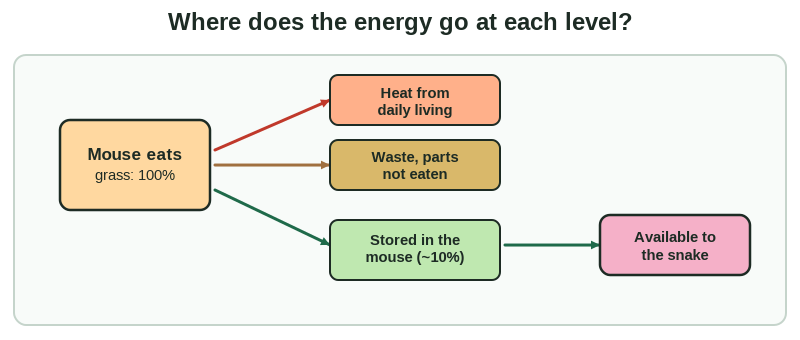
So each step up the chain has about one-tenth as much energy as the step below it:
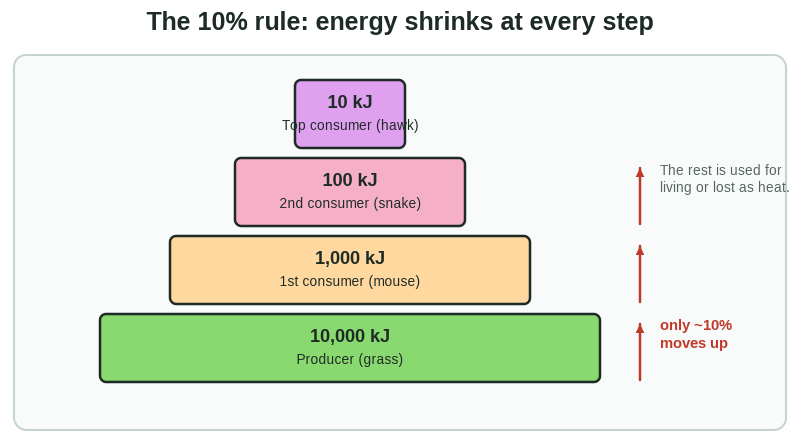
Example: If grass in a field captures 10,000 kJ of energy, the grasshoppers get about 1,000 kJ, the birds that eat the grasshoppers get about 100 kJ, and the hawk that eats the birds gets about 10 kJ. Each step just moves the decimal point one place. Keep going and a fifth link would get about 1 kJ, which is why food chains run out of room.
This explains why:
- Food chains rarely have more than four or five levels. There isn't enough energy left.
- There are far fewer hawks than mice, and far fewer mice than blades of grass.
- It takes a lot of land to support top predators.
- Eating lower on the food chain (plants) uses the available energy more directly than eating meat.
Energy flows through an ecosystem in one direction, from the Sun, into producers, up through the consumers, and out as heat. It is not recycled. (Matter is recycled. That's the next topic.)
Worth a Pause
Jesus said, "Look at the birds of the air: they neither sow nor reap... yet your heavenly Father feeds them" (Matthew 6:26). A food web is the way he does it: energy from sunlight, passed carefully from one creature to the next.
In one line: Energy flows one way, and each step keeps about a tenth.
Practice Problems
- What is the original source of energy for most ecosystems?
- Define producer, consumer, and decomposer. Give an example of each from Alabama.
- What does the arrow mean in a food chain or web?
- In the food web above, name two things the red-tailed hawk could eat. What would happen to the rat snakes if the mice disappeared?
- State the 10% rule. Where does the other 90% go?
- Producers in a meadow capture 50,000 kJ. About how much energy is available to the third level (secondary consumers)?
- Why do food chains rarely have more than 4 or 5 levels?
- Why is a food web more stable than a food chain?
View Practice Problem Solutions →
Play to Practice
Try It: Alabama Wilds: Web Builder. Read an Alabama forest food web, predict what happens when an organism disappears, and follow the 10% rule. Play »
Try It: Alabama Wilds: Energy Pyramid. Follow the energy up a food chain and see why only about 10% moves up each level. Play »