Topic 7.1: Meiosis and Gametes: Making Sperm and Eggs
You have 46 chromosomes, and your egg or sperm cell carried only 23. If they carried 46, your kids would have 92, and their kids 184. Something has to cut the number in half, and that something is meiosis.
Here's a number to remember: the chromosomes from your two parents can be shuffled into a single egg or sperm cell in about 8.4 million different ways, just from 23 pairs (2 multiplied by itself 23 times). Meiosis is a shuffle, not just a split.
The person who first saw that chromosomes come in pairs was studying grasshoppers.
In 1902, a young American named Walter Sutton, who had grown up on a farm in Kansas, was studying the sperm cells of a big grasshopper under the microscope. He noticed something strange. Just as Mendel's "factors" came in pairs, the grasshopper's chromosomes came in pairs too. And during the special division that makes sperm, the two chromosomes in each pair went to different cells.
Sutton realized that this lined up perfectly with what Mendel had found 40 years earlier in pea plants: each parent passes on only one of each pair. The chromosomes were the carriers of Mendel's factors. That insight, the chromosome theory of inheritance, linked two separate stories (Mendel's peas and Flemming's threads from Topic 3.1) into one.
Today's topic is the special cell division that Sutton was watching: meiosis.
Why We Need Meiosis
Your body cells are diploid (2n). They have 46 chromosomes in 23 pairs: one chromosome in each pair came from your mother and one from your father. The two chromosomes in a pair are called homologous chromosomes (homologs). They carry the same genes in the same order, though they may carry different versions (alleles) of those genes.
If a sperm and an egg each had 46 chromosomes, a baby would have 92, and the next generation would have 184. So reproductive cells must have half the number: 23 chromosomes (haploid, n). Those cells are called gametes (sperm in males and eggs in females). When a sperm fertilizes an egg, the two halves combine to restore the full number of 46.
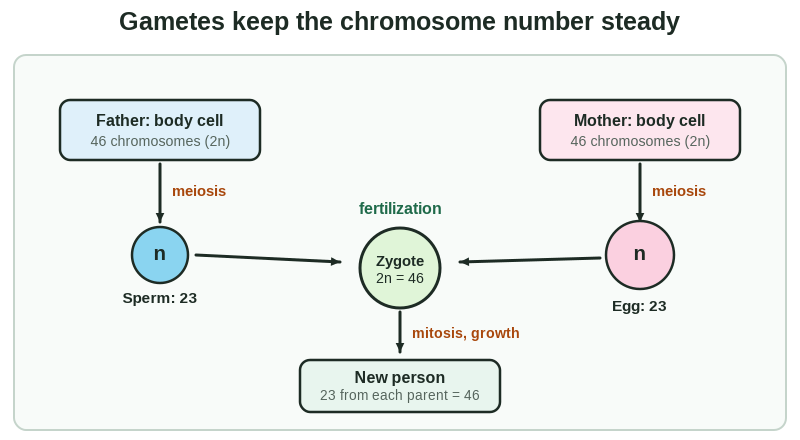
Think of a homologous pair as two copies of the same textbook from two different publishers: the same chapters in the same order, but with slightly different wording here and there. Those wording differences are the alleles.
Mitosis vs. Meiosis
Both start with a cell that has copied its DNA. They end very differently:

| Mitosis | Meiosis | |
|---|---|---|
| Purpose | Growth, repair, replacement | Make gametes |
| Divisions | 1 | 2 |
| Cells made | 2 | 4 |
| Chromosome number | Same as parent (2n) | Half of parent (n) |
| Daughter cells | Identical | Genetically different |
| Where | Body cells | Reproductive organs |
The Stages of Meiosis
Meiosis has two rounds of division, meiosis I and meiosis II, with only one round of DNA copying beforehand.
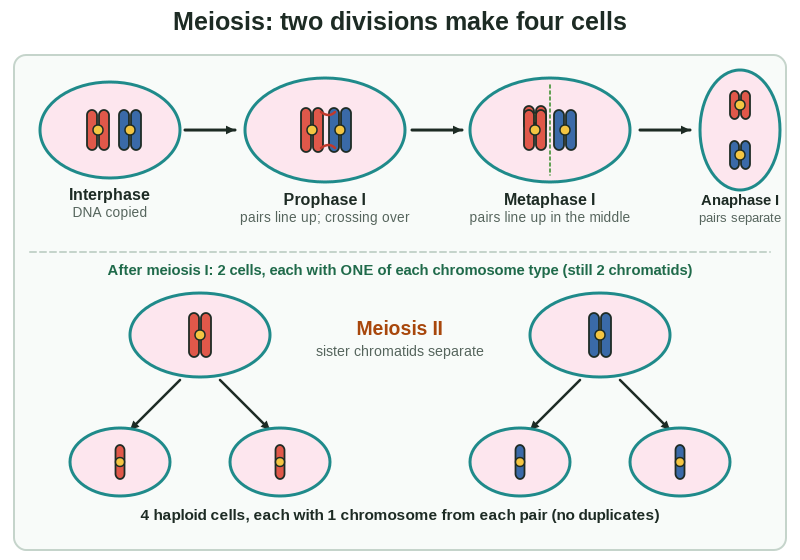
Meiosis I separates the homologous pairs:
- Prophase I: the chromosomes condense, and each chromosome pairs up with its homolog. They swap pieces (crossing over, next topic).
- Metaphase I: the pairs line up in the middle of the cell.
- Anaphase I: the two chromosomes in each pair are pulled to opposite ends. (The sister chromatids stay together.)
- The cell splits: 2 cells, each with one copy of every kind of chromosome (haploid).
Meiosis II looks like mitosis. In each of the two cells, the sister chromatids line up and separate. The result is four haploid cells.
A good way to remember the difference: meiosis I splits the pairs of chromosomes; meiosis II splits the chromatids (just like in mitosis).
In People
In males, meiosis makes sperm, four from each starting cell, continuously from puberty on. In females, meiosis in the ovaries makes eggs: one large egg from each starting cell, and the rest are tiny cells that don't survive. Either way, each gamete carries 23 chromosomes: 22 non-sex chromosomes (autosomes) plus one sex chromosome (X in an egg; X or Y in a sperm).
Worth a Pause
Psalm 139 says "you knitted me together in my mother's womb." The knitting began long before that, with two cells, each carrying half a set of instructions, finding each other. Meiosis is why you are one of a kind.
In one line: Meiosis cuts the number in half and shuffles the deck.
Practice Problems
- What does diploid mean? What does haploid mean? Give the human numbers.
- What are homologous chromosomes? Where did each one come from?
- Why must gametes be haploid? What would happen if they were diploid?
- List three differences between mitosis and meiosis.
- A cell with 8 chromosomes (2n = 8) goes through meiosis. How many chromosomes are in each gamete? How many gametes are produced?
- What separates in meiosis I? What separates in meiosis II?
- A human body cell has 46 chromosomes. How many does a sperm have? How many does a zygote have?
- Explain how Walter Sutton connected chromosomes to Mendel's factors.
View Practice Problem Solutions →
Play to Practice

Try It: Family Tree Village: Gamete Maker. Compare mitosis and meiosis, count chromosomes in gametes, and put the stages of meiosis in order. Play »
Try It: Growth Garden: Mitosis Phases. Click the cell that matches the clue: interphase, prophase, metaphase, anaphase, or telophase. Play »