Topic 7.4: Beyond Simple Dominance: Incomplete Dominance, Codominance, and Blood Types
Mom is blood type A. Dad is blood type B. Their kid could be A, B, AB, or O, any of the four. Mendel's peas were tidy, with two forms of each trait and one always winning. Real inheritance has a lot more going on.
And blood types matter for a very practical reason: the wrong blood in a transfusion can kill. That is exactly how they were discovered.
Early blood transfusions were a gamble. Sometimes a patient recovered. Sometimes a patient died within minutes, and no one knew why. In 1901 an Austrian doctor named Karl Landsteiner mixed blood samples from his colleagues and noticed that some combinations clumped together and others didn't. He had discovered the ABO blood groups. Because of his work, transfusions became safe and routine, and he received the Nobel Prize in 1930.
Blood type turned out to be inherited in a way Mendel's peas didn't show. This topic covers the patterns that go beyond simple dominant and recessive.
Review: Complete Dominance
In complete dominance, the heterozygote (Tt) looks the same as the dominant homozygote (TT). One allele fully masks the other. That is what Mendel's peas showed.
Incomplete Dominance: A Blend
In incomplete dominance, neither allele is completely dominant. The heterozygote has a phenotype in between the two homozygotes.
Classic example: Snapdragons (and four o'clock flowers). A red flower (RR) crossed with a white flower (WW) gives all pink flowers (RW).
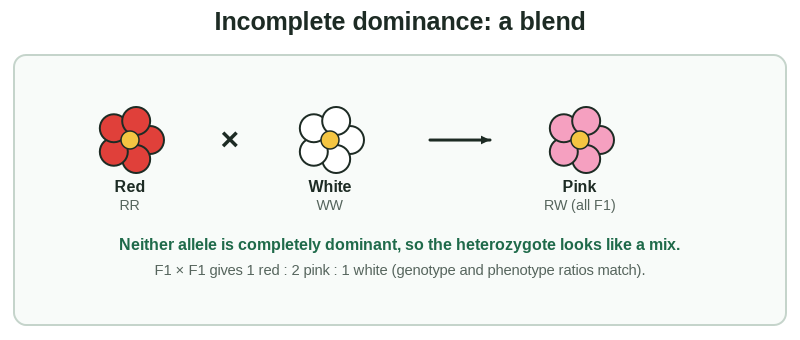
Cross two pink plants (RW × RW) and you get 1 red (RR) : 2 pink (RW) : 1 white (WW). Here the genotype ratio and phenotype ratio are the same (1:2:1), a clue that incomplete dominance is at work.
Codominance: Both Show
In codominance, both alleles are fully expressed in the heterozygote. You don't get a blend; you get both traits at once.
Example: In some cattle, a red cow (RR) and a white cow (WW) have a roan calf (RW) with a coat of both red and white hairs, not pink.
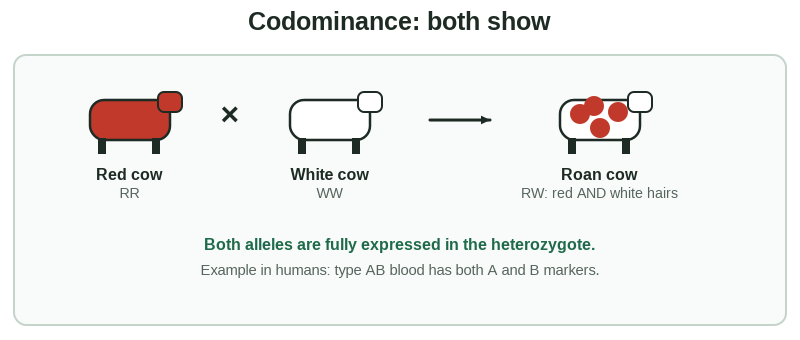
A quick test: blend (pink) means incomplete dominance. Both visible side by side (spots or patches, red AND white) means codominance. Think of paint versus polka dots: mixing red and white paint gives pink (incomplete dominance), while a red-and-white polka-dot shirt shows both colors at once (codominance).
Multiple Alleles: Human Blood Types
So far each gene had two alleles. Many genes have more than two alleles in the population, although each person still carries only two. The ABO blood group gene has three alleles:
- A and B are codominant with each other.
- O is recessive to both.
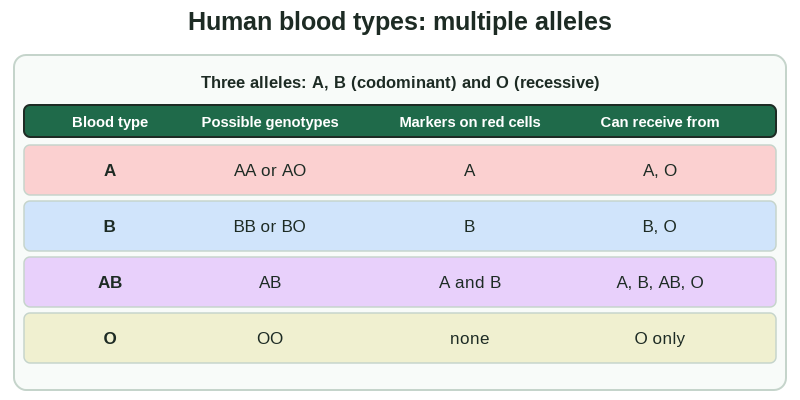
- Type A: genotype AA or AO.
- Type B: genotype BB or BO.
- Type AB: genotype AB (both alleles show: codominance).
- Type O: genotype OO.
Use a Punnett square: a parent with type A (AO) and a parent with type B (BO) can have children of all four blood types: AB (A×B), A (A×O), B (O×B), and O (O×O).
Blood also has an Rh factor (the + or − in "O positive"), which is controlled by a separate gene where + is dominant.
Sex-Linked Traits
Genes on the X chromosome show a different pattern. Females have two X chromosomes (XX); males have an X and a Y (XY). Because males have only one X, a single recessive allele on that X shows up in them. That is why conditions like red-green color blindness and hemophilia are much more common in males.
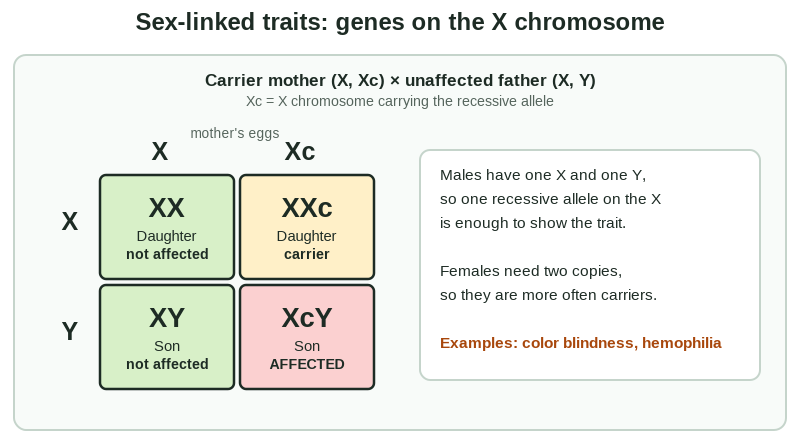
The numbers show the pattern: about 1 in 12 males has red-green color blindness, compared with about 1 in 200 females.
Worth a Pause
"For you formed my inward parts; you knitted me together" (Psalm 139:13). Even a single trait like blood type has layers of detail: three alleles, two of them codominant, one recessive, all fitted so that a transfusion can save a life. The more patterns we learn, the more there is to admire.
In one line: Real inheritance has more patterns than dominant and recessive.
Practice Problems
- What is the difference between incomplete dominance and codominance? Give an example of each.
- A red snapdragon (RR) is crossed with a white one (WW). What is the genotype and phenotype of the offspring? What if two of those offspring are crossed?
- A roan cow (RW) is crossed with a roan bull (RW). What fraction of the calves are roan?
- List the possible genotypes for blood types A, B, AB, and O.
- A mother has type AB and a father has type O (OO). What blood types can their children have? Show the Punnett square.
- Why can a person only have type AB if they inherited an A allele from one parent and a B from the other?
- In humans, why are X-linked recessive conditions like color blindness more common in males?
- A carrier mother (X, Xc) has children with an unaffected father (X, Y). What is the chance a son is affected? A daughter?
View Practice Problem Solutions →
Play to Practice

Try It: Family Tree Village: Blood Type Lab. Match genotypes to ABO blood types, predict children's blood types, and tell complete, incomplete, and codominance apart. Play »

Try It: Family Tree Village: Punnett Lab. Fill in the Punnett square, then read the offspring: dominant, blended, and codominant traits. Play »