Topic 8.2: Are Viruses Alive?
Is a virus alive? Biologists still argue about it, and by the end of this topic you'll know why.
A virus can't eat, grow, or move on its own. Left alone, it just sits there, more like a speck of dust than a creature. But get it inside a cell, and it takes over the machinery and makes thousands of copies of itself, sometimes in a matter of hours. Every cold and every flu you've ever had was one of these doing exactly that.
We didn't even know viruses existed until we chased a mystery through sick tobacco plants.
In 1892, a Russian botanist named Dmitri Ivanovsky was trying to find out what was ruining tobacco plants with a disease called tobacco mosaic. He crushed the diseased leaves and squeezed the juice through a porcelain filter fine enough to catch every known bacterium. The filtered juice still made healthy plants sick. Six years later, a Dutch scientist named Martinus Beijerinck repeated the experiment and decided the cause was a "contagious living fluid."
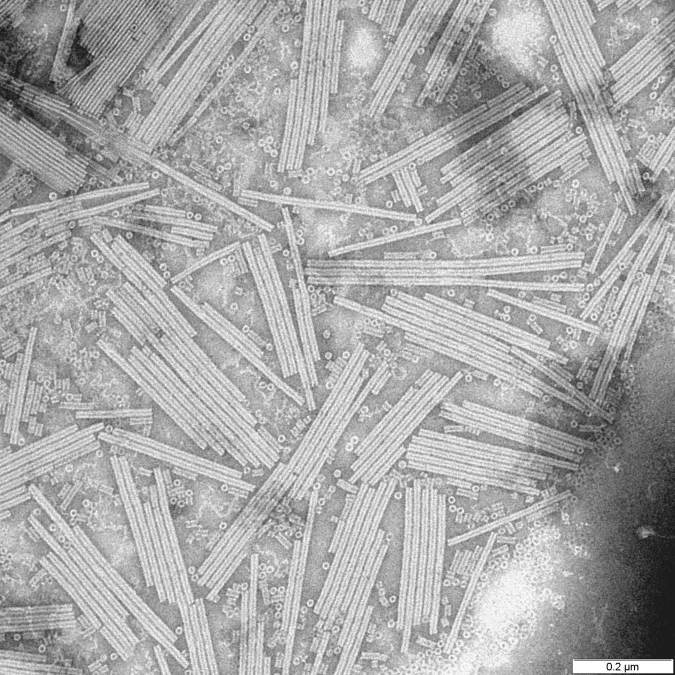
Then in 1935, American biochemist Wendell Stanley did something that startled everyone: he purified the tobacco mosaic agent and it formed crystals, like salt or sugar. Living things don't form crystals. Yet this crystal-forming substance could still infect a plant. Stanley received a Nobel Prize in 1946.
So what is a virus: a tiny living thing, or a chemical that behaves like one? The 2023 Alabama standards ask students to evaluate the evidence for placing viruses in a separate category from living things.
What Is a Virus?
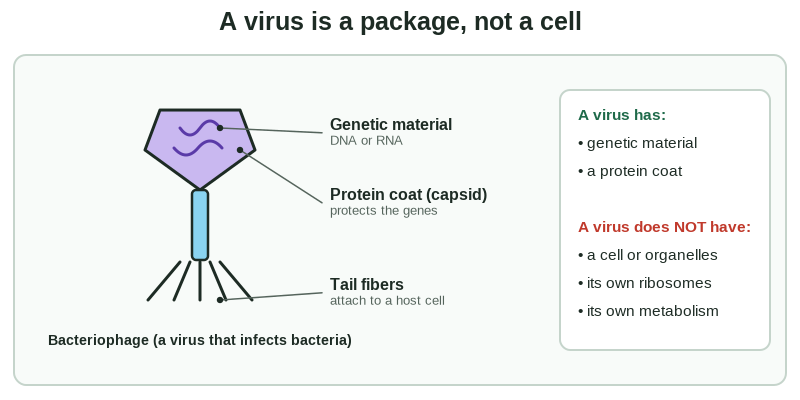
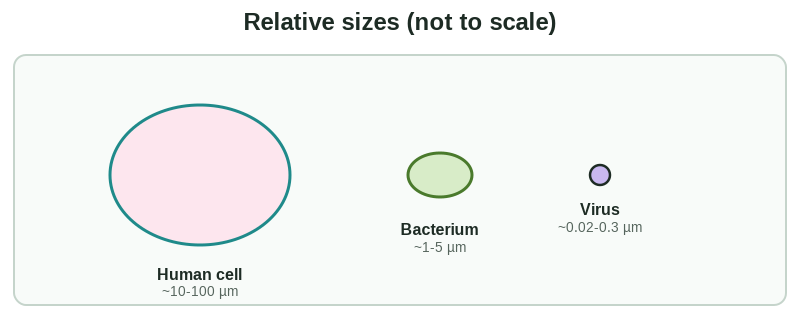
A virus is a tiny particle made of genetic material (DNA or RNA) wrapped in a protein coat called a capsid. Some also have an outer envelope. They are far smaller than bacteria and most human cells. Many viruses are about 10 to 100 times smaller than a bacterium.
How a Virus Reproduces
A virus can't reproduce on its own. It must get inside a host cell and use the cell's machinery. There are two main patterns:

- Lytic cycle: the virus attaches, injects its genes, takes over the cell to make new viruses, and the cell bursts, releasing them.
- Lysogenic cycle: the viral DNA inserts into the host's DNA and is copied each time the cell divides, staying hidden, until a trigger switches it to the lytic cycle. (This is how a virus like HIV or the one that causes cold sores can hide for years.)
The Evidence: Alive or Not?
Biologists use a checklist of the characteristics of life. How does a virus score?

Evidence that viruses should be in a separate category from living things:
- They are not made of cells.
- They have no metabolism: they don't take in or use energy on their own.
- They can't reproduce without a host cell.
- They don't grow or maintain homeostasis.
- Outside a host they are inert particles (some can even be crystallized).
Evidence on the other side:
- They carry genetic material and pass it on.
- They evolve over generations (for example, flu viruses change from year to year).
- Inside a host they act in very life-like ways.
Most biologists conclude that viruses are best placed outside the categories of cellular living things: they are a unique kind of biological entity, "on the border." Some scientists argue they should count as living because they evolve. The disagreement is a good example of how scientists define categories from evidence.
Why It Matters
- Antibiotics don't work on viruses. Antibiotics target features of bacterial cells, such as their cell walls, and viruses have no cell walls. This is why a doctor won't prescribe antibiotics for the flu or a cold.
- Vaccines train the body's immune system to recognize a virus before it causes serious illness. (That's why you need a new flu shot every year: the flu virus keeps changing.)
- Antiviral drugs can interfere with specific steps of a virus's reproduction.
Worth a Pause
Whatever category viruses end up in, they remind us how much remains to be explored. Job 38 and 39 ask Job a long run of questions about the natural world, and the lesson of that passage is humility. The more we learn, the more there is to ask.
In one line: A virus has genes but no cells, and it cannot copy itself without a host.
Practice Problems
- What two main parts make up a virus?
- Why can't a virus reproduce on its own?
- Compare the lytic cycle and the lysogenic cycle.
- List three characteristics of life that viruses lack when they are outside a host.
- What is one characteristic of life that viruses do show? (Hint: the flu changes year to year.)
- Wendell Stanley crystallized a virus. Why did this make scientists question whether viruses are alive?
- A doctor says antibiotics won't help your flu. Explain why.
- Make an argument for placing viruses outside living things, and one argument for including them. Which do you find stronger?
View Practice Problem Solutions →
Play to Practice
Try It: Check a virus against the characteristics of life in Tree of Life: Virus Check. Play Tree of Life: Virus Check »